
'Mala Guru Bead Meaning: How to Use the Finishing Bead'
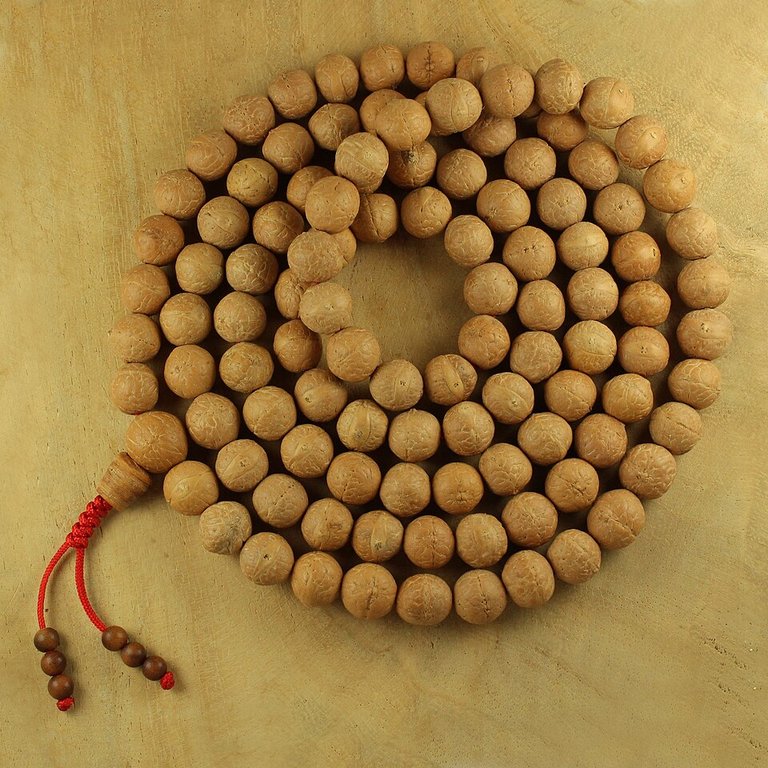
A 108-bead bodhi-seed prayer mala resting in loose coils. Photograph: TibetanMalaShop, CC BY 4.0, via Wikimedia Commons. — TibetanMalaShop, 108 Bodhi Seed Mala Beads (21 October 2017), own work, via Wikimedia Commons.

I put the mala on the linen in my dining room, with the cord and beads spread out. This amulet is called a Mala. At a simple level, a mala is a string of beads used for counting mantras. By using a mala during meditation, you can concentrate your mind, stay present, and achieve a state of deep relaxation.
A survey customer writes: “I am happy with what I am currently. Some moments are horrible some moments are peaceful. I am content with the present moment. Please bless I get the ability to help those in need in whatever way I am capable of. May food and help be there when I need it. May I always be in one with my inner divinity. Thank You.”
At this point, you might be wondering, how do I use a mala? You can also meditate using the mala by counting the beads. Simply sit down at a comfortable location and turn the beads one by one as you count your mantras.
Find the finishing bead
The guru bead is usually the larger finishing bead where the cord meets. Guru means teacher. For some practitioners, it recalls their teacher or the teachings. It generally isn't counted.
Get to know the rest of the strand
Each bead moves easily to count during your meditations. Move the beads through your fingertips one by one, breathing slowly with each movement. There can be a lovely little clicking noise as you move around them. Take a few deep breaths to center and align yourself with your intention.
A full mala commonly has 108 counting beads. Do this 108 times, traveling around the mala, until you reach the guru bead once again. This tells you that you have completed a full cycle. For another round, our meditation instructions say: “If you want to continue your meditation, instead of passing over the guru bead, simply reverse direction and begin again.”
I read this passage from Monier-Williams's 1889 account as an outsider's historical description:
> The commonest Buddhist rosaries are made of wood, or pebbles, or berries, or bone; the more costly, of turquoise, coral, amber, or silver, or even of pearls and gems. If a rosary made of the bones of some holy Lama can be procured, it is of course prized above all others. Sometimes a Dorje is appended. Northern Buddhist worshippers hold their rosaries (like Roman Catholics) in the right hand, and move on the beads with the left, and they will do this while talking together or even quarrelling. In China and Japan Buddhist rosaries are often arranged in two rings. They sometimes consist of enormous beads with relics in the central bead.
This records variety, not today's guru-bead rule or a universal modern method.
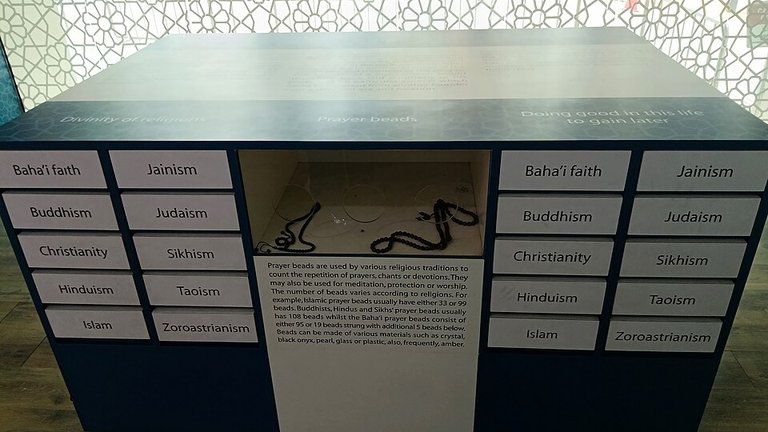
Prayer-bead exhibit at Masjid An-Nahdhah's Harmony Centre. This modern display is not an illustration from the 1889 book. Photograph: M. Adrian Jurhami, CC BY 4.0, via Wikimedia Commons. — M. Adrian Jurhami, Prayer beads exhibit in the Harmony Centre (28 August 2026), own work, via Wikimedia Commons.

So how do you use a mala for meditation?
Find a clear place to sit and about 5–15 minutes of uninterrupted time. Choose a mantra for your meditation practice. A mantra is a word or a sentence that is repeated during meditation. If you are interested in activating your Third Eye, we recommend using the powerful Aum Mantra when meditating. Follow your teacher's mantra and method. The original guide says: “You need to choose a mantra that's aligned with the powers of the malas.” For an informal Third Eye practice: “So you should choose a mantra like ‘I am open to the wisdom of my Third Eye’. Or, ‘Awaken my inner vision’.” Personal affirmations; traditional mantras vary.
1. Get comfortable in a quiet space where you won't be disturbed.
2. Hold your mala in your dominant hand and drape it over your middle finger. Hand and finger use vary; follow your teacher's method where it differs.
3. Select your mantra - a positive affirmation that will help you stay centered and grounded.
4. Close your eyes and take a few deep breaths to center yourself.
5. Begin reciting your mantra, using your thumb to move from one bead to the next on the mala.
6. When you reach the guru bead, turn the mala around and continue moving your thumb in the same direction. Many practitioners reverse rather than cross this uncounted bead; follow your lineage's instruction.
7. Continue meditating with the mala, repeating your mantra and focusing on your breath.
8. When you're finished, take a few deep breaths and slowly open your eyes.
With each new bead repeat your chosen mantra.
Remember, it's normal for your mind to wander during meditation. When you catch yourself getting distracted, simply bring your focus back to your mantra and mala.
How do I use a mala?
Hindu, Buddhist and Jain traditions don't share one universal rule for handling prayer beads.
The simplest way to use the mala is to just wear it. A mala can be worn like a necklace, or like a bracelet by wrapping it twice around the wrist, if it fits without stretching. However, to truly use the mala to its full potential, you need to meditate with the mala. If your tradition gives guidance about wearing, follow that too.
For more about the stone, there is also our lapis lazuli mala guide.
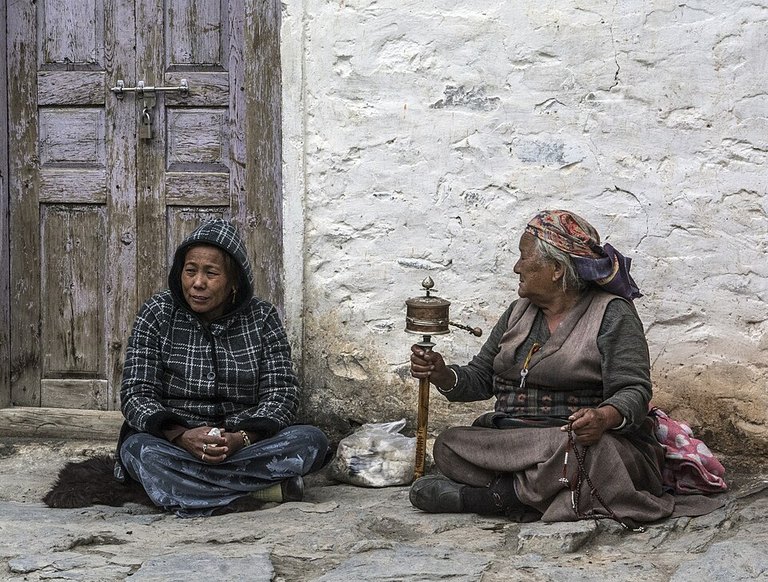
Women praying in Nepal, photographed in 2018. One holds a prayer wheel and bead strand. Photograph: Anton Gutmann, CC BY-SA 4.0, via Wikimedia Commons; resized and JPEG-compressed. This is not the nineteenth-century Lhasa scene described in the text. — Anton Gutmann, Evening pray (9 May 2018), own work, via Wikimedia Commons.

A strand to look at
The Lapis Lazuli Third Eye Mala is one example made with 108 Lapis Lazuli beads. Each little blue lapis lazuli bead looks like a little globe. A customer review describes “the weight, and the craftsmanship” and “The heavy duty cord that runs through the beads.”
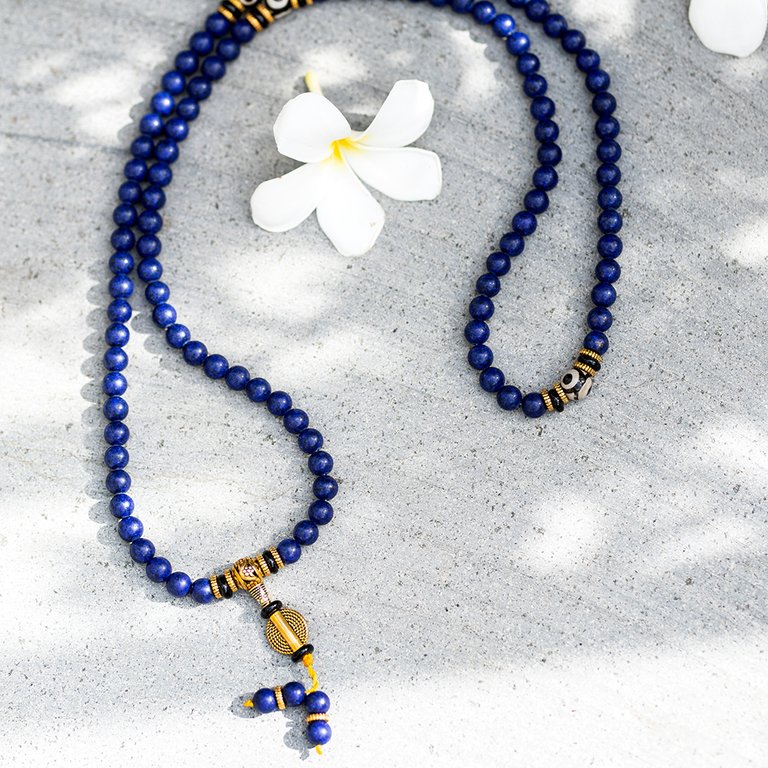
The Lapis Lazuli Third Eye Mala shown in the current Karma Items product listing.
Michele Bruns
About Michele Bruns
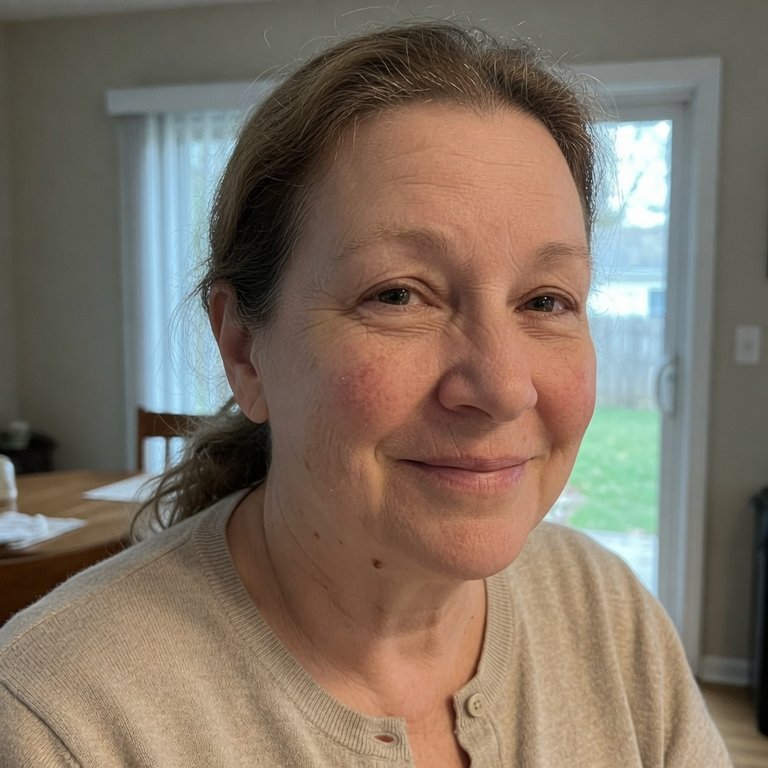
Michele Bruns works out of the dining room of a brick ranch in Kettering, Ohio. After the last child left she bought a folding table, a sheet of linen, and a weekend reflexology certificate in Dayton. She puts one object on the sideboard and leaves it while people come and go. If you ask, she will tell you where she put it. She will not give a speech.