
Understanding the 7 Angels of Solomon Wealth Manifestation Ring
Every emphasis is laid on the wisdom of Solomon and his wealth.
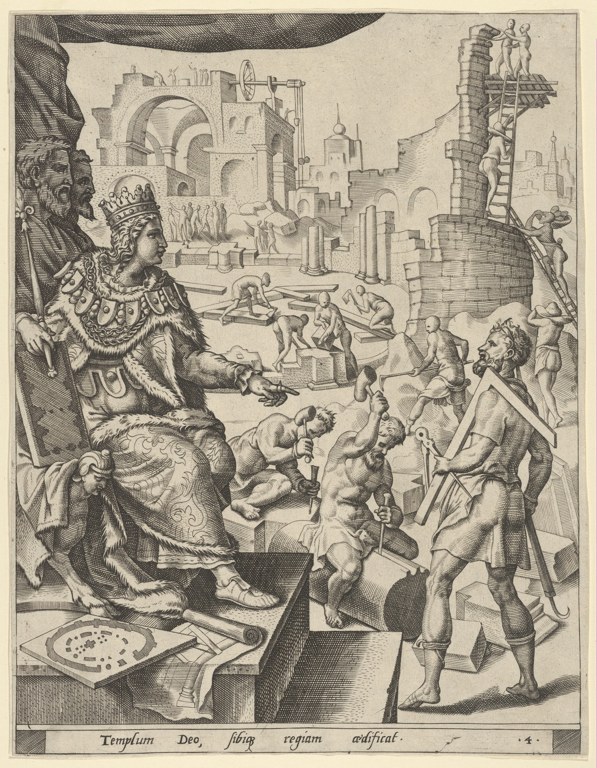
Solomon overseeing the building of the Temple, in a 1554 engraving. A later artistic depiction of the biblical story. — After Maarten van Heemskerck, The Metropolitan Museum of Art
I read HVAC specifications for twenty-three years, so I separate product names before trusting brochures. The 7 Angels of Solomon Wealth Manifestation Ring needs that treatment. Its engraved face and seller’s names are visible; old books supply the ring and seal. I sorted four parts: Solomon, ring, seven angels, and wealth manifestation.
Solomon: the king before the legend
Every emphasis is laid on the wisdom of Solomon and his wealth. Yahweh appeared to Solomon in a dream and offered to grant whatever he might ask. Confessing his inexperience, the king prayed for a discerning heart, and was rewarded with the gift of wisdom together with riches and military glory. There follows an example of his sagacity: the famous story of the steps he took to determine which of two claimants was the mother of a child.
His wisdom excelled that of Egypt and of the children of the East; by the latter may be meant Babylonia, or more probably the Arabs, renowned through all ages for their shrewdness. He is also credited with an interest in botany and natural history, and later Jewish legend improved this by ascribing to him lordship over all beasts and birds and the power of understanding their speech. To this it added the sovereignty over demons.
As his fame spread abroad, people came to hear his wisdom, and costly presents were showered upon him. The sequel was the visit of the Queen of Sheba. His wealth was in proportion to his wisdom. Trading journeys were conducted with Phoenician help to Ophir and Tarshish. With the horse-breeding districts of the north he traded in horses and chariots.
Every emphasis is laid on wisdom and wealth; later Jewish legend added the sovereignty over spirits.
Ring and seal: the object and its mark
The Testament of Solomon, translated in the following pages, was published in a volume of anecdota by Fleck in the year 1837. Seven years later, in 1844, Bomemann made a German translation in the pages of the Zeitschrift für die histor. Theologie. Conybeare’s English translation appeared in The Jewish Quarterly Review in 1898.
It has been regarded by the few scholars who have examined it as a Christian work written as late perhaps as the fifth century of our era. The following is the drift of the Testament. King Solomon is engaged in the work of building the Temple, and in him dwells a supernatural power, the wisdom, also called the spirit and glory of God. In virtue of the immanence in him of this power, Solomon has power over the spirits of the air, of the earth’s surface, and of the nether world.
The Testament opens rather abruptly with the descent of the spirit Ornias upon Solomon’s servant. Solomon goes into the nearly completed Temple and prays for help to the Lord Sabaoth. Grace is granted him, and the archangel Michael brings him a ring, of which the stone was engraved with a pentalpha. This ring endows its possessor with power over all the spirits in the story.
The translation says Michael brought a little ring, having a seal consisting of an engraved stone, and said: “Take, O Solomon, king, son of David, the gift which the Lord God has sent thee, the highest Sabaoth. With it thou shalt lock up all the spirits of the earth; and with their help thou shalt build up Jerusalem. But thou must wear this seal of God. And this engraving of the seal of the ring sent thee is a Pentalpha.”
The heaven-sent ring is described, and the power of Solomon over the spirits ascribed to the wisdom communicated to him from God.
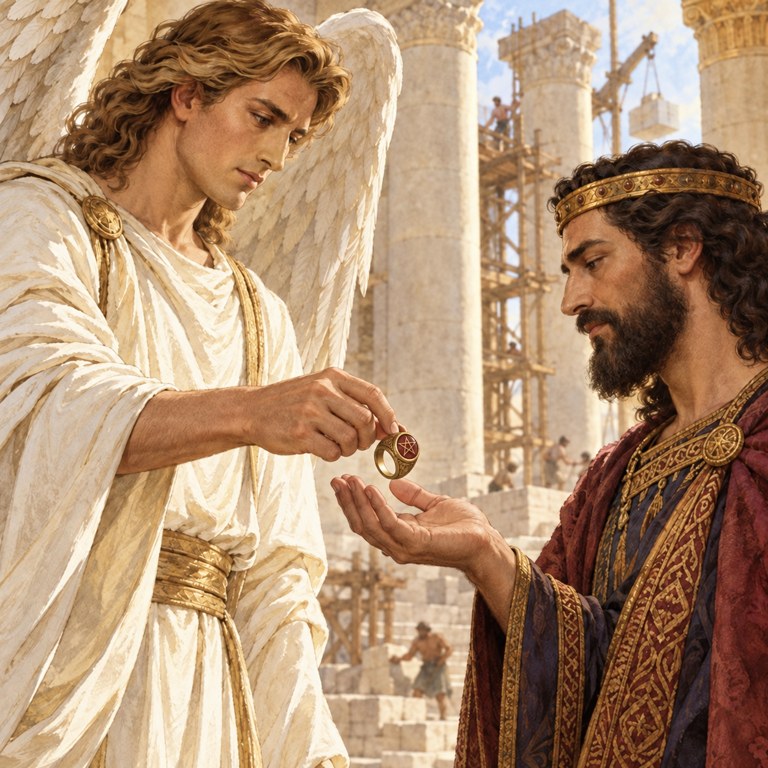
Illustration of Michael bringing Solomon the ring in the Testament of Solomon. The ring is an imagined depiction of the story, not the modern product.
The seven angels: one selected list
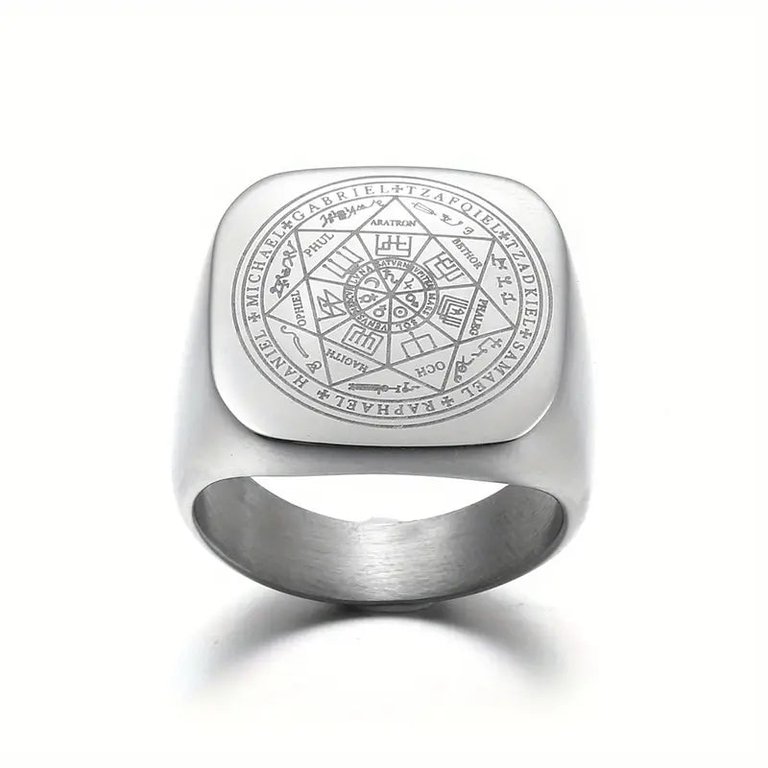
The storefront names Michael, Gabriel, Raphael, Uriel, Barachiel, Sealtiel, and Jehudiel. I did not find those seven gathered in one passage of the Hebrew Bible or in one passage of The Testament of Solomon.
Armed with the ring, Solomon calls up before him all the spirits, and asks of each in turn his or her name, as well as the name of the star or constellation or zodiacal sign, and of the particular angel to the influence of which each is subject. One after another the spirits are vanquished, and compelled by Solomon to aid in the construction of the Temple.
Now when I Solomon heard the name of the archangel, I prayed and glorified God, the Lord of heaven and earth. And I sealed the spirit and set him to work at stone-cutting, so that he might cut the stones in the Temple. I prayed the archangel Uriel to come and succour me; and I forthwith beheld the archangel Uriel coming down to me from the heavens.
Later Solomon says: “Fear God, Asmodeus, and tell me by what angel thou art frustrated.” The answer is: “By Raphael, the archangel that stands before the throne of God.” Other sections give Joel, Azael, Brieus, and forms copied from the Greek manuscripts.
Some of them require the names of several angels to be written on paper, and worn as an amulet by those who would be safe from their influence. The old text asks for the particular angel who can rout each particular spirit, and for the help of these names and sundry amulets and incantations. It does not gather the seller’s seven names into one list.
Wealth manifestation: old wealth and newer wording
His wealth was in proportion to his wisdom. Trading journeys were conducted with Phoenician help to Ophir and Tarshish. With the horse-breeding districts of the north he traded in horses and chariots, and gold accumulated in enormous quantities. Silver was regarded as stones; the precious cedars of Lebanon as sycamores. The description of his buildings accords with this representation of vast wealth and luxury.
The general impression of Solomon’s position in history is in fact seriously disturbed when the composite writings are closely viewed. Where the traditions are manifestly in a later form they are in agreement with later backgrounds, and it is questionable whether earlier forms can be safely recovered when it is held that they have been rewritten or when the historical kernel has been buried in legend or myth.
Every emphasis is laid on the wisdom of Solomon and his wealth. The king prayed for a discerning heart, and was rewarded with the gift of wisdom together with riches and military glory. “Manifestation” is newer shop language, not evidence of a financial result.
How I read a symbolic ring
Is it possible then that the Testament in its original form was the very collection of incantations which, according to Josephus, was composed and bequeathed by Solomon? Josephus proceeds to relate how a certain compatriot of his, Eleazar by name, had drawn a spirit out of a man by holding to his nose a ring which had under the seal one of the roots revealed by Solomon.
Eleazar adjured the spirit, as it left the man, never more to return into him, mentioning Solomon, and repeating over him the incantations which Solomon composed. “This incident,” concludes Josephus, “was a patent demonstration of the understanding and wisdom of Solomon.”
All this tallies quite well with the Testament, for in it the heaven-sent ring is described, and the power of Solomon over the spirits ascribed to the wisdom communicated to him from God. It is impossible to say when and where the Christian elements present in the Testament were worked into it.
The stresses laid on the name Emmanuel and on its numerical value, on the writing of the name on the forehead, and on the use of the ring all have an archaic air. The same document mixes equivocal Christianity with unequivocal Judaism. It is likely that in it we have a Christian recension of a Jewish book. The practical check is to keep each source and each visible mark in its own place.
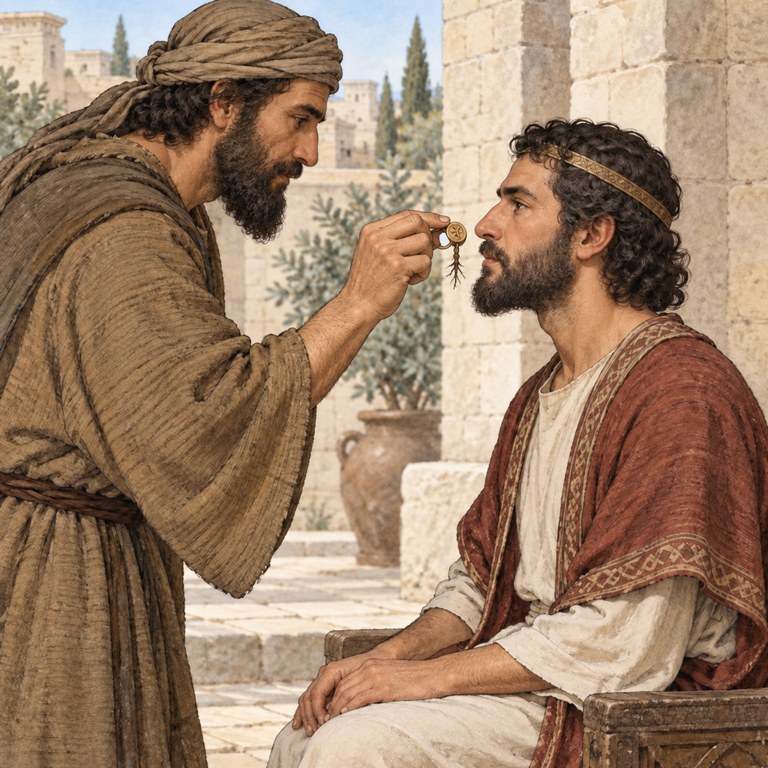
Illustration of Eleazar holding a ring beneath a man’s nose, as recounted by Josephus and discussed by Conybeare. This depicts the account, not evidence of a supernatural result.
One current specimen to examine
After the old pages, I returned to the 7 Angels of Solomon Wealth Manifestation Ring. Its broad band and flat round face leave the engraving visible. I would begin with those marks, then the sources behind them. The ring can carry an intention without making history say more than it does.
Craig Lembke
About Craig Lembke

Craig Lembke lives in Gresham, Oregon. He spent twenty-three years speccing rooftop HVAC units, then set a folding table up in the garage when the company thinned out. A resin-and-metal pyramid sits next to the laptop. He found Wilhelm Reich in a library remainder stack and still cannot tell you how much of it is solid. He wants the object explained without a speech.