
My favorite details in an amethyst tree of life bracelet
I look at the stone, the tree, and everyday wear.
At my Gresham desk, I start with George Frederick Kunz's account. My choice needn't be anyone else's. Probably the first objects chosen were those easily strung or bound together. For instance, certain perforated shells and brilliant seeds; the softer stones, wherein holes could be easily bored by the help of the simplest tools, probably came next. The harder gems must have been hoarded as pretty toys long before they could be adjusted for use as ornaments.
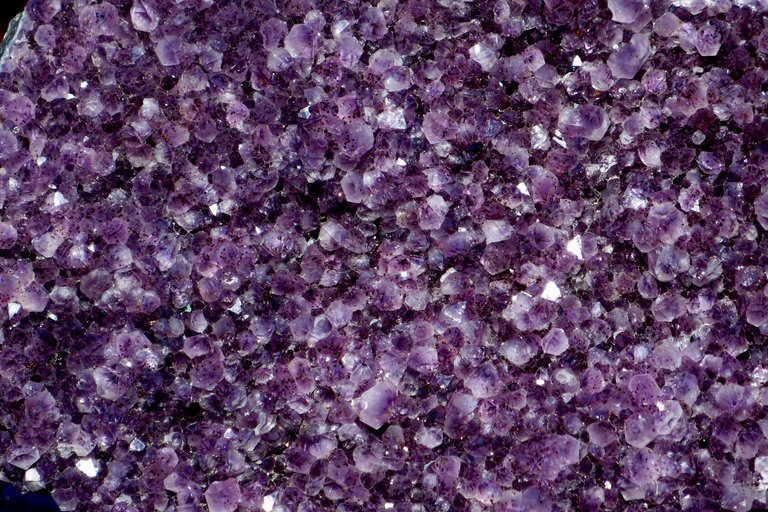
Amethyst crystals before they become jewelry. Photograph: Lisa Ann Yount, CC0, via Wikimedia Commons; resized without cropping. — Lisa Ann Yount, Amethyst crystals close (1 May 2014), via Wikimedia Commons / Flickr.

For a closer look, I start with the stone.
What am I looking at?
As an ex-HVAC spec writer, I use Frank Bertram Wade's starting point. One precious stone is best distinguished from another just as substances of other types are distinguished, by their properties. For example, salt and sugar are both white, both are soluble in water, and both are odorless. So far these properties would not serve to distinguish the two substances. But sugar is sweet while salt is salty in taste.
I start with quartz
In my field book: Rock crystal is the term applied to quartz when it is clear and colorless. Amethyst is quartz with a violet color. Clear quartz is beautiful enough to be a gem. The crystals are clear and when pure colorless. But there is a tendency for some slight impurity to color them almost any hue.
The most perfect double-ended crystals form only where growth is possible in all directions, as in clay. In cavities and caves there is an opportunity for the crystals to grow in toward the open spaces. In such places, one finds fine large crystals. The Alps, Brazil, Japan, and Madagascar are especially famous localities.
I read on. Silica is slightly soluble in water, especially when it is alkaline. Most river-, lake-, and sea-waters have some silica in solution, and are carrying it from one place to another. The waters which percolate through the rocks carry even more. When they come out into open spaces, they give up some of the silica, making crystals lining these openings, whether fissures or cavities.
I check where it sits
At the desk, I would measure my wrist and check how the closure works. I want enough room to move. A strand should not slide under my hand as I type, and a charm should not catch at the desk edge. I would check the bead size as well as the length before choosing a bracelet from a photo.
I read hardness as a scratch rating
I keep Wade's definition. By hardness is meant the ability to resist scratching. The term hardness should not be taken to include toughness. Yet it is frequently so understood by the public. Most hard stones are more or less brittle and would shatter if struck a sharp blow. Other hard stones have a pronounced cleavage and split easily in certain directions. True hardness, then, implies merely the ability to resist abrasion, or scratching.
I find the numbers useful once I know their limits. Diamond, the hardest of all gems, was rated as 10 by Mohs. This rating was purely arbitrary. Mohs might have called it 100 or 1 with equal reason. It was merely in order to represent the different degrees of hardness by numbers, that he picked out the number 10 to assign to diamonds. Quartz was given the number 7.
It may be said here that any mineral in this series, that is of higher number than any other, will scratch the other. Thus diamond will scratch all the others; sapphire will scratch any but diamond. The intervals in hardness are by no means equal to the differences in number. The numbers thus merely give us an order of hardness. I store harder stones apart.
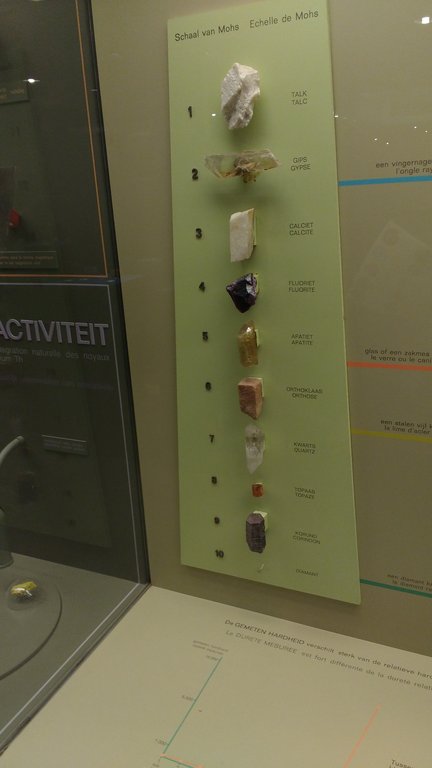
Mohs hardness display at the Royal Belgian Institute of Natural Sciences, Brussels. Photograph: Fernando Losada Rodríguez, CC BY-SA 4.0 (https://creativecommons.org/licenses/by-sa/4.0/), via Wikimedia Commons. Resized and compressed; no crop. — Fernando Losada Rodríguez, Escala de Mohs.001 - MSNBrussel (13 August 2016), via Wikimedia Commons.

With the material clear, I can choose the shade I like.
I look at the color in daylight
I like the range in Wade's description. The purple of the amethyst varies from the palest tints to the full rich velvety grape-purple of the so-called Siberian amethysts. The latter are of a reddish purple, sometimes almost red, by artificial light. But of a fine violet by daylight. If the purple is paler, however, one cannot be sure of the mineral by its color.
I also look at the surface. By the term luster we refer to the manner and degree in which light is reflected from the surface of a material. Surfaces of the same material, but of varying degrees of smoothness would, of course, vary in the vividness of their luster. Silk has so typical a luster that we speak of it as silky luster. Just as pearl has a pearly luster, so certain gems have peculiar and characteristic luster.
One may note the luster rapidly, without apparatus and without damage to the stone. We thus have a test which, while it is not conclusive except in a very few cases, will supplement and serve to confirm other tests. I stop short of a verdict.
I linger over Wade's account of the finish. The troubles of the lapidary in getting the keen polish that is so much admired on fine gems are many. In general, the polishing powder should not be quite as hard as the material to be polished. Else it may grind rather than polish. The material should be used with water or oil to give it a creamy consistency. It should be backed by laps of different materials for different purposes. A lap is the polishing wheel.
On a lap of wood, tripoli would fail to polish hard materials, but would polish amethyst or other quartz gem. A change of speed of the lap, too, changes the effect of the polishing material. Probably hardly two lapidaries would work exactly alike in their treatment of precious stones, and each guards his secrets. Yet all use approximately similar general methods. Other lapidaries produce very fine results by purely hand methods.
I give the tree room for a story
I think of growth in the tree of life shape. In Helen A. Clarke's retelling, the Norse World Tree is an ash tree called Ygdrasil. It spreads its branches over the entire universe. These widespread branches are the ethereal or celestial regions, their leaves the clouds, their buds or fruits the stars.
Four harts run across the branches of the tree and bite the buds. Perched upon the top branches is an eagle. Between his eyes sits a hawk. A squirrel runs up and down the ash. It seeks to cause strife between the eagle and Nidhögg, a monster which is constantly gnawing the roots.
Near the fountain dwell three maidens who fix the lifetime of all men, called Norns. Every day they draw water from the spring and with it sprinkle the ash Ygdrasil in order that its branches may not rot and wither away. The dew that falls from the tree upon the earth men call honey-dew. It is the food of the bees. I see care here, in this Norse story.
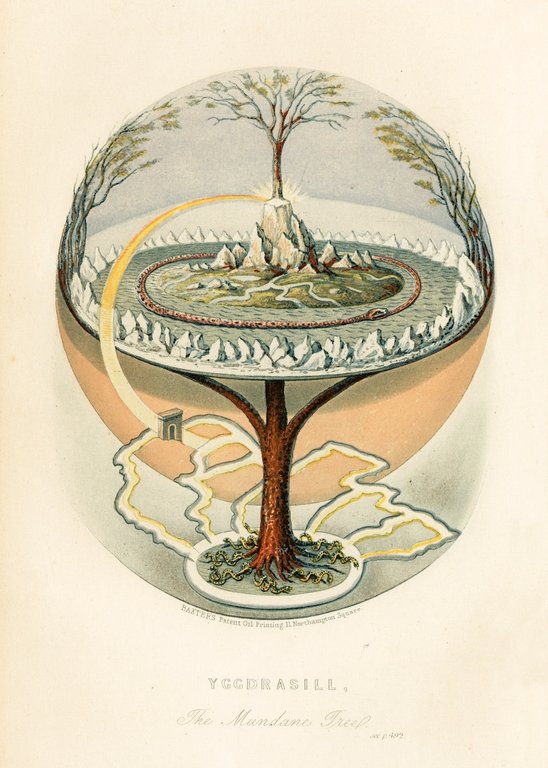
Yggdrasil, The Mundane Tree, an 1847 illustration by Oluf Bagge of the Norse World Tree. A later artistic depiction of the legend. Public domain, via Wikimedia Commons; full page retained. — Oluf Olufsen Bagge (1780–1836), Yggdrasil, The Mundane Tree, plate published in Northern Antiquities (1847); full-page reproduction via Wikimedia Commons, sourced there from The Public Domain Review.

I make room for ordinary wear
For daily use, I return to Wade's quartz notes. Crystalline quartz is fairly tough and lacks any pronounced cleavage. It is a durable stone in rings or in other mountings. In the course of time the sharp edges will wear dull from friction with objects carrying common dust. This is largely composed of powdered quartz itself, and therefore gradually dulls a quartz gem. Old amethysts that have been long in use in rings show this dulling.
I also keep his caution about testing. In the first place, it is necessary to caution the beginner against damaging a fine gem by attempting to test its hardness in any but the most careful manner. I would take it off for rough work.
I found the Amethyst Tree of Life Bracelet with those details in mind. Its listing gives 8 mm beads and describes an adjustable length. I would check the fit first.
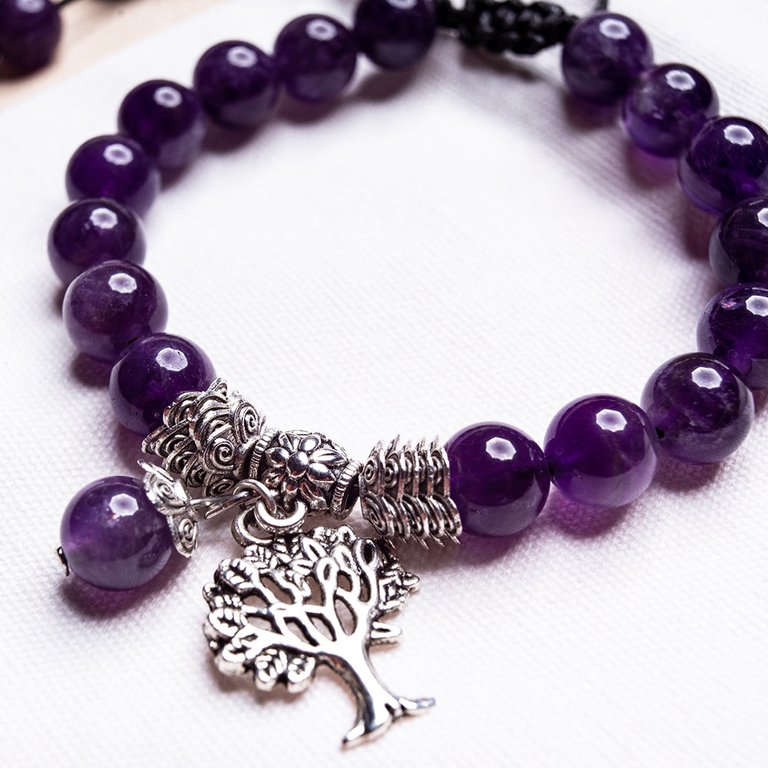
The Amethyst Tree of Life Bracelet, shown in the current Karma Items product listing.
Craig Lembke
About Craig Lembke

Craig Lembke lives in Gresham, Oregon. He spent twenty-three years speccing rooftop HVAC units, then set a folding table up in the garage when the company thinned out. A resin-and-metal pyramid sits next to the laptop. He found Wilhelm Reich in a library remainder stack and still cannot tell you how much of it is solid. He wants the object explained without a speech.