
'Ancient track for sleep: my simple evening listening routine'
A place to settle and listen comfortably.
When I cannot sit with my group, I put down my beads at home. Here I adapt William James's Talks to Teachers and The Gospel of Relaxation for evening listening.
If you miss a place to settle
We wish and expect to enjoy poetry always, to grow more and more intelligent about pictures and music, to keep in touch with spiritual and religious ideas.
Some interest in each of these things arises in everybody at the proper age. But, if not persistently fed with the appropriate matter, instead of growing into a powerful and necessary habit, it dies. It is choked by the rival interests to which the daily food is given. I recognize this: I mean to enjoy poetry, and to absorb a lot of it, of course. I fully intend to keep up my love of music, to read the books that shall give new turns to the thought of my time, to keep my higher spiritual side alive. But we do not attack these things concretely, and we do not begin today.
I choose my audio first. The NHLBI suggests quiet time in the hour before bed.

A prepared bedroom as a setting for quiet time before bed. Photograph: PattayaPatrol, 25 July 2025, via Wikimedia Commons, CC BY-SA 4.0 (https://creativecommons.org/licenses/by-sa/4.0/). Resized and compressed; no crop. — PattayaPatrol, photograph taken 25 July 2025, via Flickr and Wikimedia Commons.

If you miss the cue to begin
Putting my beads away can be the cue. We speak, it is true, of good habits and of bad habits. But when people use the word habit, in the majority of instances it is a bad habit which they have in mind. They talk of the smoking-habit and the swearing-habit and the drinking-habit, but not of the abstention-habit or the moderation-habit or the courage-habit. But the fact is that our virtues are habits as much as our vices. All our life, so far as it has definite form, is but a mass of habits: practical, emotional, and intellectual.
Our dressing and undressing, our eating and drinking, our greetings and partings, even most of the forms of our common speech, are things of a type so fixed by repetition as almost to be classed as reflex actions. To each sort of impression we have an automatic, ready-made response.
For this we must make automatic and habitual as many useful actions as we can, and as carefully guard against the growing into ways that are likely to be disadvantageous. The more of the details of our daily life we can hand over to the care of habit, the more our higher powers of mind will be set free for their own proper work.
I know this indecision: the drinking of every cup, the time of rising and going to bed every day, and the beginning of every bit of work are subjects of fresh debate. Full half the time goes to the deciding or regretting of matters which ought to be so ingrained in us as practically not to exist for our consciousness at all. I choose a listening time.
A sheet of paper or a coat, once creased or folded, tends to fall afterward into the same identical folds.
If you miss having one thing to attend to
I know this from sitting. But a little observation will show any one that voluntary attention cannot be continuously sustained. It comes in beats. When we are studying an uninteresting subject, if our mind tends to wander, we have to bring back our attention every now and then by using distinct pulses of effort. These revive the topic for a moment. The mind then runs on for a certain number of seconds or minutes with spontaneous interest. Again some passing idea captures it and takes it off. Then the acts of returning must be repeated once more. Voluntary attention, in short, is only a momentary affair. The process, whatever it is, exhausts itself in the single act. Unless the matter is then taken in hand by some trace of interest in the subject, the mind fails to follow it at all.
Try to attend steadfastly to a dot on the paper or on the wall. You presently find that one or the other of two things has happened. Either your field of vision has become blurred, so that you now see nothing distinct at all. Or else you have involuntarily ceased to look at the dot in question, and are looking at something else. But, if you ask yourself successive questions about the dot: how big it is, how far, of what shape, what shade of color; in other words, if you turn it over, if you think of it in various ways, and along with various kinds of associates, you can keep your mind on it for a comparatively long time. With audio, I return to one sound; I need not hold it still.
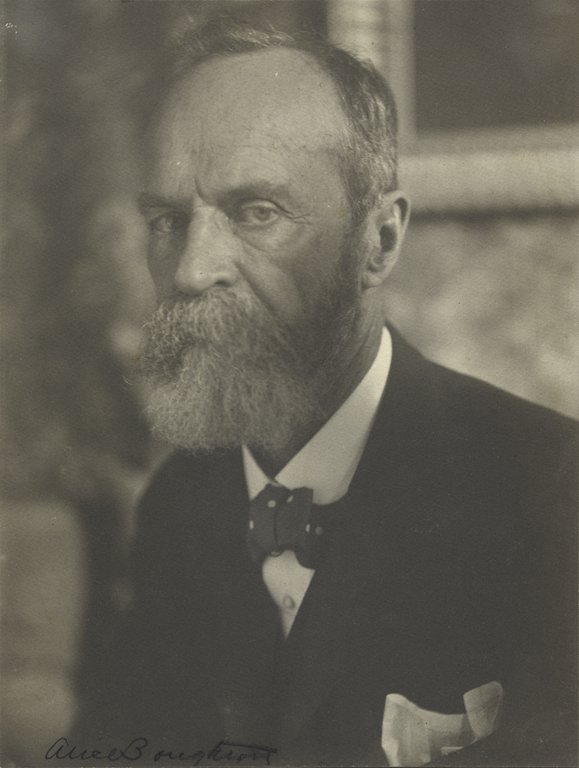
William James, whose writing on attention is adapted here. Portrait by Alice M. Boughton, circa 1907; National Portrait Gallery, Smithsonian Institution, via Wikimedia Commons. Public domain; digital image CC0. Existing Commons crop retained, resized and compressed. — Alice M. Boughton, William James, circa 1907, platinum print; National Portrait Gallery, Smithsonian Institution, NPG.87.37, via Wikimedia Commons (cropped derivative).

If you miss the feeling of ease
I can make listening into another task. Just as a bicycle-chain may be too tight, so may one's carefulness and conscientiousness be so tense as to hinder the running of one's mind.
Prudence and duty and self-regard, emotions of ambition and emotions of anxiety, have, of course, a needful part to play in our lives.
But confine them as far as possible to the occasions when you are making your general resolutions and deciding on your plans of campaign, and keep them out of the details. When once a decision is reached and execution is the order of the day, dismiss absolutely all responsibility and care about the outcome. Unclamp, in a word, your intellectual and practical machinery, and let it run free. I listen without checking whether I feel sleepy yet. The next bead can wait.
If you miss a comfortable place to rest
I notice my chair. Well, in one sense the more or less of tension in our faces and in our unused muscles is a small thing: not much mechanical work is done by these contractions. But it is not always the material size of a thing that measures its importance: often it is its place and function.
If you never wholly give yourself up to the chair you sit in, but always keep your leg- and body-muscles half contracted for a rise, it is worth noticing.
I let the chair take my weight and check the headphones for pressure. For bedtime, the NHLBI suggests a cool, dark, quiet room. I keep the volume low and comfortable.
Check headphone pressure and keep the volume low and comfortable. Generic listening equipment, photographed by Sprinno, 22 July 2011, via Wikimedia Commons, CC0. Original dimensions retained. — Sprinno, Headphones on white background, 22 July 2011, own work via Wikimedia Commons.

If you miss knowing when you have done enough
The need of feeling responsible all the livelong day has been preached long enough here. Even now I fear that I may be making an undying resolve to become strenuously relaxed, cost what it will, for the remainder of my life. It is needless to say that that is not the way to do it. The way to do it, strange as it may seem, is genuinely not to care whether you are doing it or not.
I give myself leave to stop. The NIDCD explains that loudness and exposure time both matter for hearing. If the headphones hurt or the sound bothers me, I take them off.
A recording for the routine
Ancient Track for Sleep is digital audio. The listing says to use headphones while lying down. I check comfort first; it is no promise of sleep.

The current Karma Items listing cover for Ancient Track for Sleep, a digital audio recording. — Karma Items, current Ancient Track for Sleep Shopify product listing media.
From my South Tucson card table,
Gloria Cardenas
About Gloria Cardenas

Gloria Cardenas lives in South Tucson, in the stucco house she bought in 1988. She strings malas at a card table with a faded beach towel under the beads so they don't roll onto the linoleum. A sitting-group teacher in the late nineties made her count 108 without looking down. She still does it that way. She keeps one finished strand on a nail by the kettle.