
Blue Tiger’s Eye Bracelet Guide to Everyday Wear
Stone lore, smooth beads and moving light.
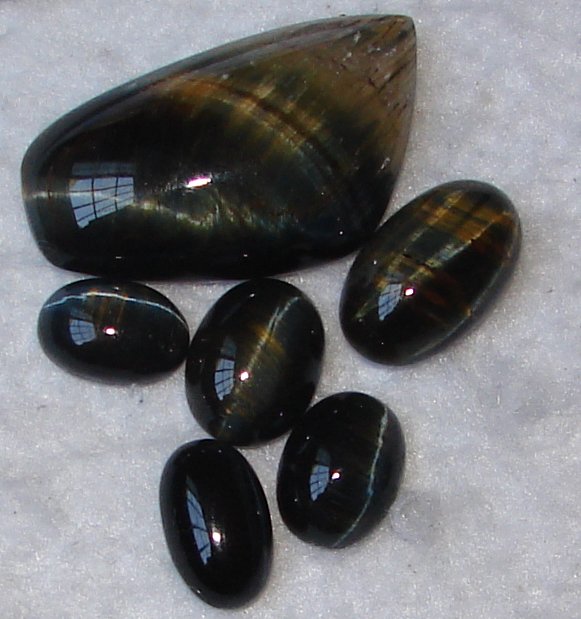
Polished Hawk’s Eye from Minas Gerais, Brazil. Photograph: Eurico Zimbres; polishing: Afonso Marques. CC BY-SA 3.0 (https://creativecommons.org/licenses/by-sa/3.0/); recompressed without cropping. — Eurico Zimbres; stones polished by Afonso Marques

At my folding table in Gresham, I start with meaning, feel, light and everyday wear.
Stone lore
Blue tiger’s eye is also called Hawk’s Eye. The Pavitts’ 1922 book traces protective stone lore.
The origin of talismans and amulets is lost in the obscurity of the ages. But as far back as we can trace human records they are to be found. The meaning of these two words is entirely distinct.
A talisman in olden times was a symbolic figure, whether engraved in stone or metal, or drawn upon parchment or paper. It was worn both to procure love and to avert danger from its possessor. The latter purpose alone was the object of the amulet.
I keep the idea of a thought made concrete in the form of a talisman or amulet. It may be made for some specific purpose, or for particular wear. It becomes to the wearer a continual reminder of its purpose. The Pavitts saw this as strengthening him in his aims and desires.
Symbols, frequently of a religious nature, have formed the basis of talismans and charms from earliest times. They hold a very important place in the affairs of humanity. In modern religions, each symbol is used in accordance with the character of ceremonial worship. Colour also plays a very important part in the service.
I carry the watchful-eye association into everyday wear.
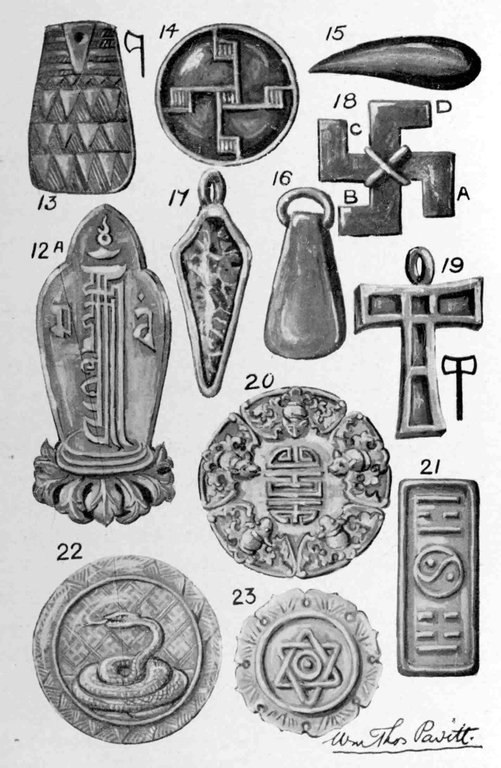
Plate 1 from the Pavitts’ The Book of Talismans, Amulets, and Zodiacal Gems (1922): primeval, Chinese, Indian and Tibetan talismans. Historical illustration from the cited book. — William Thomas Pavitt and Kate Pavitt / Project Gutenberg
Bead feel
Before the full beauty of a stone can be appreciated it has to be cut and polished. It is cut either with facets, or in the form known as cabochon: a rounded top.
Practically all transparent stones are cut with facets. The best and most popular form is the brilliant cut. This has been found so effective with diamonds. The term brilliant has become the recognised name for a diamond cut in this manner.
Stones such as moonstones, opals, agates, turquoises and cornelians are usually cut en cabochon. Amethysts, rubies, emeralds and sapphires are also frequently cut in this fashion. Wade explains the rounded form.
It was natural that the earliest cut stones should have the simple rounded lines of the cabochon cutting. First came the rubbing down of sharp edges and the polishing of the whole surface of the stone.
The term comes from a French word for a head. The usual round cabochon cut closely resembles the top of a head in shape.
Cabochon cut stones usually have a flat base. Sometimes a slightly convex base is used, especially in opals and in moonstones. Some stones of very dense color are cut with a concave base to thin them and thus to reduce their color.
The contour of the base may be round, or oval, or square, or cushion shape, or heart shape. The top is always smooth and rounding and unfacetted: without flat faces. The relation of the height or thickness to the length or width may be varied. It can suit the size and shape of the rough piece.
It may suit one’s ideas of symmetry. This applies to an opaque stone, such as turquoise or lapis lazuli.
Cutting and polishing are separate steps in Wade’s account. The rubbing down process does not leave a facetted surface, but only a coarse roughly rounded or flattened surface. The surfaces need only to be smoothed. They are then ready for polishing.
The polishing is usually done by workers who do not cut stones. They do nothing but polish them. In small shops, however, the same lapidary performs all the parts of the work. A lapidary is a stone cutter. Each gem material requires special treatment to obtain the best results.
A bead is rounded all around. I want room beneath my cuff.
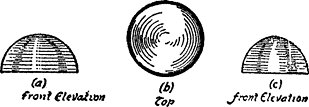
Figure 11, “Cabochon Cutting,” from Frank Bertram Wade’s A Text-Book of Precious Stones (1918). Front elevations and top view; this describes a cabochon, not the bracelet’s all-around beads. — Frank Bertram Wade / Project Gutenberg
Blue bands and light
Cat’s-eye and tiger’s-eye owe their peculiar appearance to the presence, within them, of many fine, parallel, silky fibers. Parallel means side by side.
Such stones, when cut en cabochon, show a thin sharp line of light running across the center of the stone. This happens when properly cut with the base parallel to the fibers. It is due to reflection of light from the surfaces of the parallel fibers. The line of light runs perpendicularly to the fibers: across them at a right angle.
In these cases, the individual stone is usually easily distinguished from other kinds of stones by its peculiar behavior towards light. But the more valuable chrysoberyl cat’s-eye may be confused with the cheaper quartz cat’s-eye. One must be well acquainted with the respective appearances of the two varieties. Whenever there is any doubt other tests should be applied.
Cabochon cut stones, however, have a quiet beauty of color which commends them to people of quiet taste. Even fine rubies, sapphires and emeralds are cut cabochon. I watch the bright band against blue tiger’s eye’s deep blue-black body.
Everyday wear
I would remove the bracelet for rough work.
By hardness is meant the ability to resist scratching. The term hardness should not be taken to include toughness. Yet it is frequently so understood by the public. Most hard stones are more or less brittle and would shatter if struck a sharp blow. Other hard stones have a pronounced cleavage and split easily in certain directions. True hardness, then, implies merely the ability to resist abrasion, or scratching.
Hardness is very necessary in a precious stone. It allows the stone to receive and keep a fine polish.
The possessor of diamonds and other stones should avoid keeping them loose in the same jewel case or other container. The shaking together may result in the scratching of the softer materials.
Wade recounts a legend to the effect that the diamond is an angry stone. It should not be allowed to associate with other stones lest it scratch them. I would give the bracelet its own space.
One bracelet
The Blue Tiger’s Eye Aura Protection Bracelet lists natural Hawk’s Eye beads, an 8 mm bead size and an adjustable fit. The listing describes deep blue-black color with moving bands of light and notes that the stone patterns vary from piece to piece.
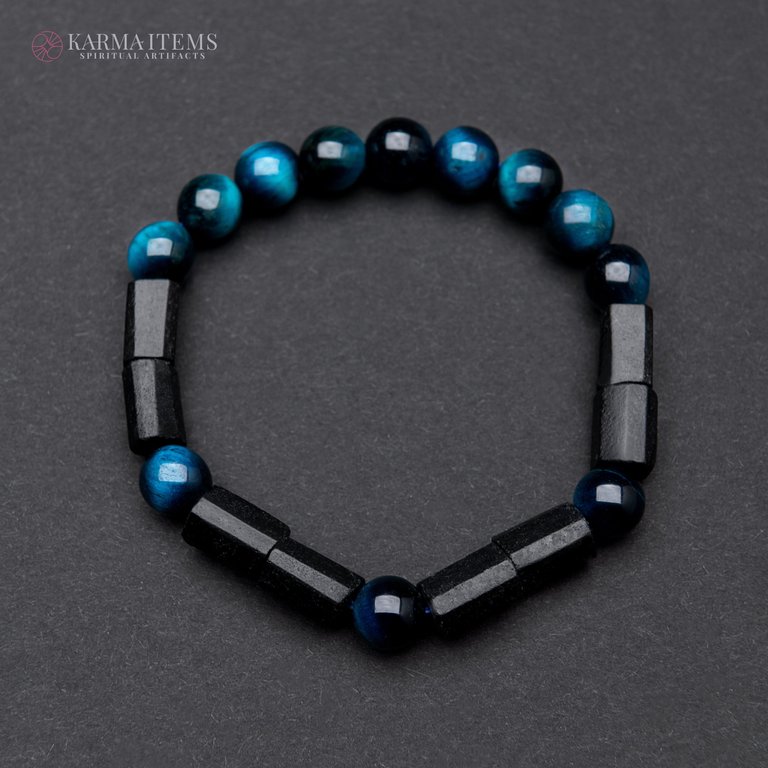
The current Blue Tiger’s Eye Aura Protection Bracelet, shown in the store’s overhead product photograph. — Karma Items
Craig Lembke
About Craig Lembke

Craig Lembke lives in Gresham, Oregon. He spent twenty-three years speccing rooftop HVAC units, then set a folding table up in the garage when the company thinned out. A resin-and-metal pyramid sits next to the laptop. He found Wilhelm Reich in a library remainder stack and still cannot tell you how much of it is solid. He wants the object explained without a speech.