
Orgonite Pyramid Materials: Resin, Metal, and Crystal
Resin holds the shape. Metal pieces are set through it. A crystal is included in the cast. That is the short materials list. The rest of the answer is in the object and in whatever the maker has taken the trouble to state.
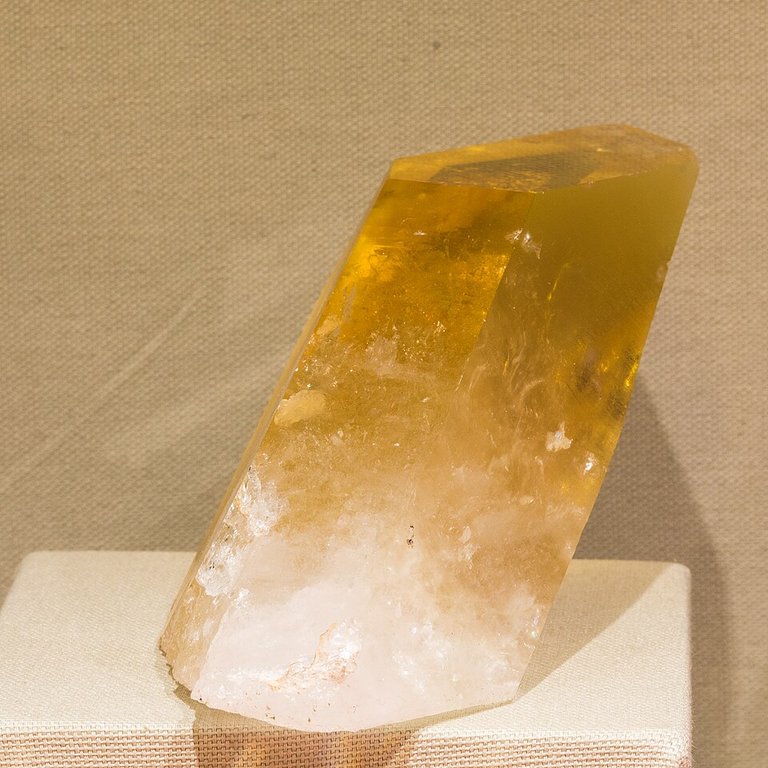
Citrine, the yellow variety of quartz, from Bahia, Brazil. Photograph: Raimond Spekking, CC BY-SA 4.0, via Wikimedia Commons. — Raimond Spekking, Citrine — Bahia, Brazil, via Wikimedia Commons.

I keep a pyramid beside the laptop on a folding table in my garage. Turn it and there are chips, a stone, a coil, a few bubbles, the line left by the mold.
The owners do not write like catalogues. “It’s beautifully crafted.” “Nice colors and lightweight.” “Came quickly, looks like I expected, well packaged.” One was surprised by the size. One keeps it on a dining-room side table and waits for the sun because the color is “jus spectacular.” Another has it on a desk. Another put twelve around the house.
If you want the wider story first, the guide to what orgonite is covers the name and history. Here I am looking at what has been cast together.
Resin
Resin is the body. It flows into a mold and around the inclusions. After the cure, it keeps the point, faces, metal, and stone in one object.
The finished surface tells part of the story. Clear or cloudy. Smooth across the face or rough at an edge. A bubble may come from hand casting; a deep crack or broken point is another thing. “The Item arrived on time and in Excellent Condition. I thinks it looks great and I am Satisfied with it.” Another owner wrote, “I really don’t know what to say about this piece. It is a very beautiful crafted Charm.”
In the orgonite account, resin supplies the organic side of an organic-and-metallic construction. The physical job is narrower: it holds the inclusions and fixes the form.
The label may stop at the word resin. If it does, the exact type is unknown. A category name is not a recipe.
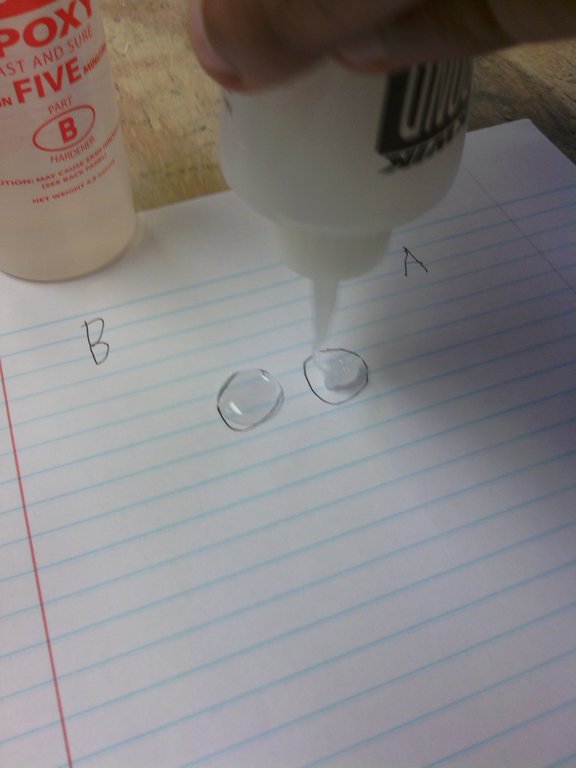
One clear component of a two-part epoxy setup being poured onto ruled paper beside a separate drop marked B. Photograph: Ehaynes7928, CC BY-SA 3.0, via Wikimedia Commons. — Ehaynes7928, Pour Epoxy, own work, via Wikimedia Commons.

Metal pieces
Metal may show as small chips, curls, flakes, wire, or a shaped coil. I look through more than one face. A glint may be metal, glitter, foil, or only light on a polished surface.
The metal has a named place in the orgonite idea. The product account calls the result a compact device made to process and amplify life-force energy.
That does not identify the alloy. Copper, brass, aluminum, and steel are different. If a listing says only metal pieces, leave the alloy open.
One owner wrote: “Craftwork Nicely done… I haven’t experienced anything + or - since putting it in my sacred place.” That order makes sense to me. Workmanship is available for inspection. A personal result is a different question.
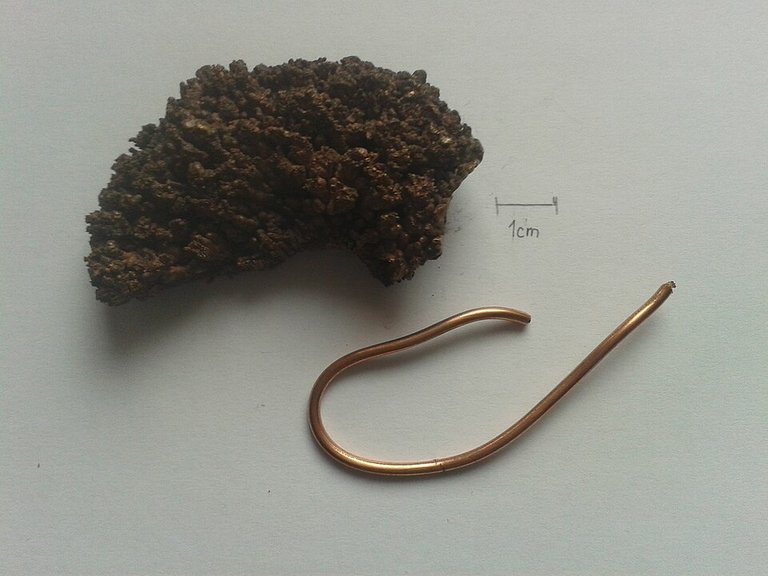
Native copper crystals beside copper wire. This is a material example, not an identification of the product's exact metal. Photograph: Best Sci-Fatcs, CC BY-SA 4.0, via Wikimedia Commons. — Best Sci-Fatcs, Copper Wire and Crystals, via Wikimedia Commons.

Crystal inclusion
The crystal is usually the first inclusion to receive a name. Citrine, amethyst, quartz, and obsidian are not decorative synonyms. The description should tell you which stone is in the cast. The photographs should show whether it appears as chips, rough pieces, a larger point, or a layer.
A. E. H. Tutton began Crystals with sand grains under a microscope. Some showed “a beautiful coating of transparent quartz.” Under suitable conditions, he wrote, “a perfect little quartz crystal will radiate out from the sand grain, composed of a miniature hexagonal prism terminated by the well-known pyramid.”
He then moved from the little grain to the larger idea:
> This marvellously everlasting power possessed by a crystal, of silent imperceptible growth, that is, of adding to its own regular structure further accretions of infinitesimal particles, the chemical molecules, of its own substance, is one of the strangest functions of solid matter, and one of the fundamental facts of science which is rarely realised, compared with many of the more obvious phenomena of nature.
Tutton’s next definition is still worth reading in full:
> A crystal in the ordinary sense of the word is solid matter in its most perfectly developed and organised form. It is composed of the chemical molecules of some definitely constituted substance, which have been laid down in orderly sequence, in accordance with a specific architectural plan peculiar to that particular chemical substance.
He continued by setting the rigid crystal against other states of matter:
> The physical properties of the latter are such that it assumes the solid form at the ordinary temperature and pressure, leaving out of consideration for the present the remarkable viscous and liquid substances which will be specially dealt with in Chapter XVI. of this book, and which are currently known as “liquid crystals.” This term is not perhaps a very appropriate one. For the word “crystal” had much better be left to convey the idea of rigidity of polyhedral form and internal structure, which is the very basis of crystal measurement.
Then he described the change from liquid to crystal:
> The solid crystal may have been produced during the simple act of congealment from the liquid state, on the cooling of the heated liquefied substance to the ordinary temperature. Sulphur, for instance, is well-known to crystallise in acicular crystals belonging to the monoclinic system under such conditions, a characteristic crop being shown in Fig. 2 (Plate I.); they were formed within an earthenware crucible in which the fusion had occurred, and became revealed on pouring out the remainder of the liquid sulphur when the crystallisation had proceeded through about one-half of the original amount of the “melt.”
Tutton also described crystals growing from solution:
> Or again, the crystal may have been deposited from the state of solution in a solvent, in which case it is a question of the passage of the substance from the liquid to the solid condition, complicated by the presence of the molecules of the solvent, from which the molecules of the crystallising solid have to effect their escape. Fig. 4 (Plate II.) represents crystals of potash alum, for instance, growing from a drop of saturated solution on a glass slip placed on the stage of the microscope, the drop being spread within a hard ring of gold size and under a cover-glass, in order to prevent rapid evaporation and avoid apparent distortion by the curvature of an uncovered drop. The crystals are of octahedral habit like those of oxide of arsenic, but many of them also exhibit the faces of the cube.
And then the short version of his whole argument:
> In any case, however it may be erected, the crystal edifice is produced by the regular accretion of molecule on molecule, like the bricks or stone blocks of the builder, and in accordance with an architectural plan more elaborate and exact than that of any human architect. This plan is that of one of the thirty-two classes into which crystals can be naturally divided with respect to their symmetry. Which specific one is developed, and its angular dimensions, are traits characteristic of the substance.
The example is sulphur, not citrine. The useful part is the distinction between material, internal structure, and outer form.
A crystal has its own internal order. The cast has an outside form made by a mold. Those are not the same fact. A quartz crystal can carry its structure when it is rough, chipped, polished, or partly hidden. A resin pyramid gets its four sides and point from the cast.
For citrine, I want the description to say citrine, not only yellow crystal. I want to see where it lies. I do not expect every chip to have the same shade or outline. Natural stone varies, and a hand-cast arrangement varies with it.
The spiritual account calls citrine the Merchant’s Stone and gives it a prosperity role. In this construction, the pyramid geometry is said to concentrate and focus the orgone field. Stone identity, cast quality, and spiritual purpose are separate statements.
Read the actual product description
Use the three-part list as a check, not as permission to guess.
For the resin, ask if the type and finish are stated. For the metal, ask if the metal or alloy is named. For the crystal, look for the exact stone and how it sits in the cast. If the page does not say, leave it unknown.
Then look at the form. One owner says it is “too small I never expected.” Another writes, “It sits in a wonderful place in our home.” Measurements beat an average of reactions.
The current description for the specimen below gives citrine a manifestation role. It tells the owner to place the piece in a workspace, living room, or meditation area, or hold it during meditation. Those are the stated use and purpose. They do not name every material specification.
One specimen on the table
The Citrine Orgonite Pyramid of Manifestation is one current object to inspect against that list. Read its description. Turn through all the photographs. Find the resin body, the visible metal pieces, and the citrine inclusion. If a detail is not stated, keep it as an unanswered question instead of making the photograph say more than it can.
A little uncertainty does not ruin the object. It is simply the difference between what I can see, what the maker says, and what I may decide to believe.
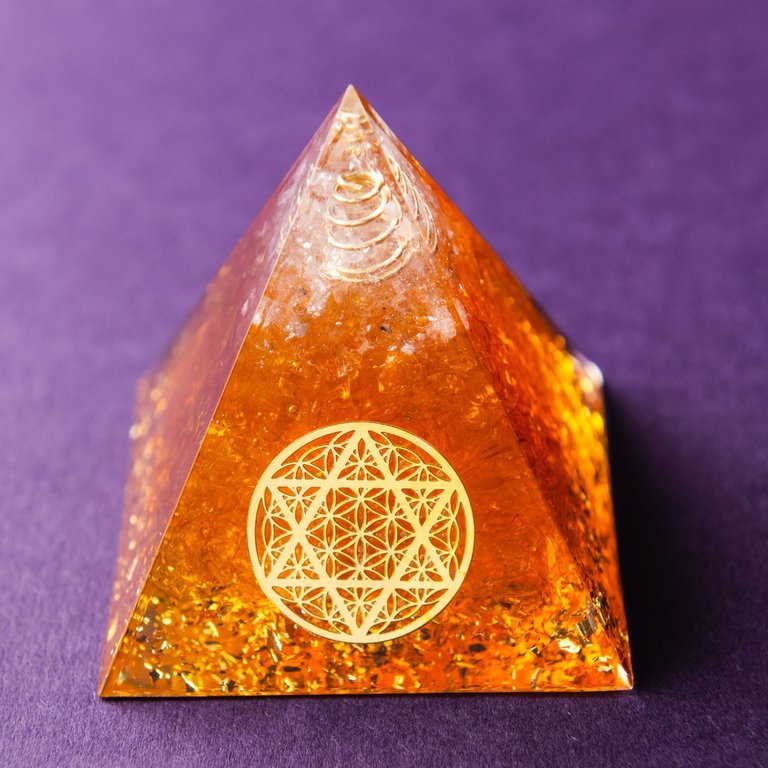
The Citrine Orgonite Pyramid of Manifestation shown in the current Karma Items product listing.
From the folding table in my garage,
Craig Lembke
About Craig Lembke

Craig Lembke lives in Gresham, Oregon. He spent twenty-three years speccing rooftop HVAC units, then set a folding table up in the garage when the company thinned out. A resin-and-metal pyramid sits next to the laptop. He found Wilhelm Reich in a library remainder stack and still cannot tell you how much of it is solid. He wants the object explained without a speech.