
Tree of Life Jewelry Meaning: 4 Ways to Read the Design
Roots, trunk, branches, and stones can carry different meanings. I use four ways to choose one that is mine.
At my card table in South Tucson, loose beads stay on a faded beach towel. A tree charm rolls until one little branch catches in the cloth. That is when I look closer.
George Frederick Kunz wrote in 1913: Probably the first objects chosen for personal adornment were those easily strung or bound together—for instance, certain perforated shells and brilliant seeds. The softer stones, wherein holes could be easily bored by the help of the simplest tools, probably came next. The harder gems must have been hoarded as pretty toys long before they could be adjusted for use as ornaments.
I turn the piece in my hand. I look at the roots first, then the trunk, branches, and anything set beside them.
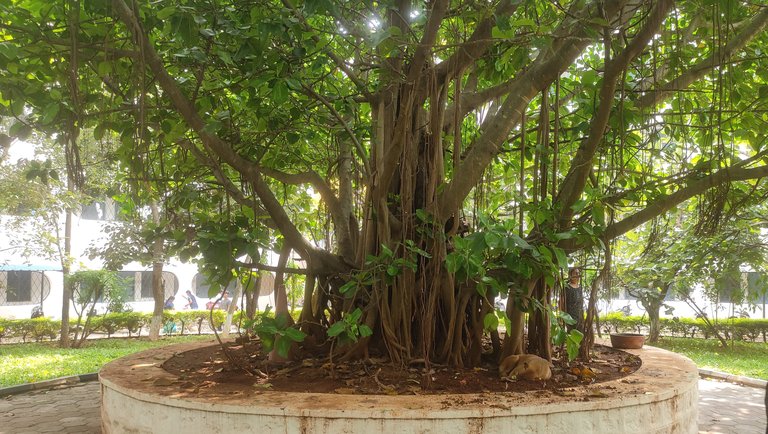
A banyan tree with a wide branching canopy. Photograph: Moniruj, CC0, via Wikimedia Commons; resized without cropping. — Moniruj, Tree of Banyan, 3 October 2024, via Wikimedia Commons.

There is no single tree of life jewelry meaning shared by every culture and every wearer. Helen A. Clarke's A Guide to Mythology, published in 1908, puts very different tree stories next to one another. I use it as an old collection, not the final word on living traditions.
A tree may matter because of family, faith, memory, or simply its shape. The old accounts offer ways to look. They do not require one answer.
1. Recognize what the branches gather
Even in Greek mythology, the idea of descent from trees had not quite died out. Clarke recalls a moment in the Odyssey. Penelope says to Odysseus, while he is still in the disguise of a beggar, so that she does not recognize him, “Now, I pray, declare thy lineage, for thou surely art not sprung from the old fabulous oak nor from the rock.”
The oak was regarded with very great reverence by the Greeks. They declared it to be the first tree that grew upon the earth, its acorns being the earliest food of man. There is an old story to the effect that the Deluge was due to quarrels between Zeus and Hera. When the waters subsided, an oaken statue emerged, supposed to be a symbol of peace between the king of gods and his consort.
When the imagination begins to sprout a little more, the story tells how the first men and animals were made out of trees by some divinity. Thus Glooskap, the Algonquin divinity, made man in this way: “He took his bow and arrows and shot at trees, the basket tree, the ash. Then Indians came out of the bark of the ash trees.”
In Norse mythology there is a similar legend, according to which there were no intelligent men on earth until there came three mighty and benevolent gods to the world. Men had no sense, nor blood, nor motive powers, nor goodly color. Odin gave spirit, Haemir gave sense, and Lodur gave blood by bestowing it upon the senseless ashes and elms.
These stories keep their own names and homes. On a small piece of jewelry, the branches can still give visible form to ancestry or a group held by one center. I ask: what do I want this tree to keep together?
2. Compare cultural meanings without flattening them
The worship of trees is told of in stories from one end of the world to the other. Clarke records an Ainu account that at the beginning of the world the ground was so hot that the creatures called men even got their feet burnt. For this reason no tree or herb could grow. The only herb that grew at that time was the mugwort. Of trees the only ones were the oak and pine. For this reason these two trees are the oldest among trees. This being so, these two trees are divine; they are trees which human beings worship.
She sets beside it a very different image. According to the Rig Veda, she writes, the god Brahma himself was a tree and all the other gods were considered branches of the divine parent stem. There is also a supernatural tree sacred to Buddha. This cloud tree is the tree of knowledge and wisdom and is covered with divine flowers. It glows and sparkles with the brilliance of precious stones. The root, the trunk, the branches, and the leaves are formed of gems.
Beneath this tree Buddha, at whose birth a flash of light pierced through all the world, sat down with the firm resolve not to rise until he had attained the knowledge which makes free. Then the tempter Mara advanced with his forces. Encircling the sacred tree, hosts of demons assailed Buddha with fiery darts, amid hurricanes, darkness, and floods of water, to drive him from the tree. Buddha maintained his position unmoved, and at length the demons were compelled to fly.
One account points to sacred beginnings. Another turns toward knowledge and resolve. I do not press them into “all trees mean growth.” If I choose knowledge, I can say so. If I choose steadiness, I can say that too.
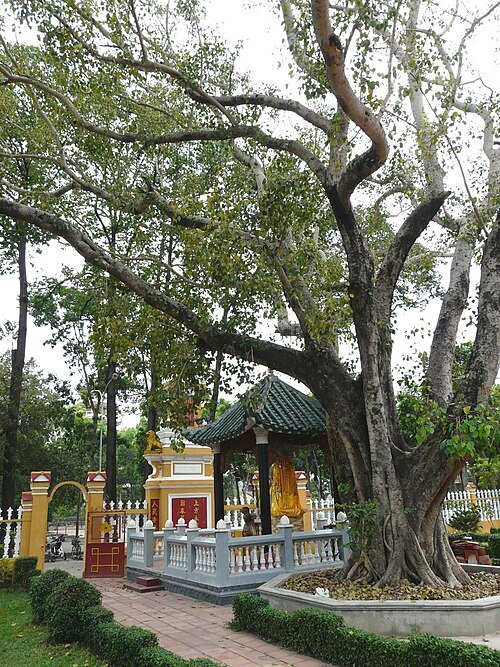
A bodhi tree in the gardens of Giac Lam Pagoda, Ho Chi Minh City. Photograph: DoktorMax, public domain, via Wikimedia Commons. — DoktorMax, Bodhi tree at Giac Lam Pagoda, January 2008, via Wikimedia Commons.

3. Read the tree and the other details together
The Norse World Tree is an ash called Ygdrasil. One of the stems of this tree springs from the central primordial abyss, from the subterranean source of matter, runs up through the earth which it supports, and, issuing out of the celestial mountain in the world's center, spreads its branches over the entire universe. These widespread branches are the celestial regions, their leaves the clouds, their buds or fruits the stars.
Four harts run across the branches of the tree and bite the buds. Perched upon the top branches is an eagle, and between his eyes sits a hawk. A squirrel runs up and down the ash and seeks to cause strife between the eagle and Nidhögg, a monster which is constantly gnawing the roots.
Another stem springs from the holy Urdan-fountain where the gods sit in judgment. In this fountain swim two swans. Near the fountain dwell three maidens who fix the lifetime of all men, called Norns. Every day they draw water from the spring and with it sprinkle the ash Ygdrasil in order that its branches may not rot and wither away. The dew that falls from the tree upon the earth men call honey-dew, and it is the food of the bees.
The third stem of Ygdrasil takes its rise in the cold and cheerless regions of the North, over the source of the ocean, which is typified by a spring called Mirmir's Well, in which wisdom and wit lie hidden. Mirmir, the owner of this spring, is full of wisdom because he drinks of the waters.
In this story the whole universe is symbolized as a tree. Yet each detail changes what I see. Roots bring depth. Water brings care. Stars bring reach. Creatures bring movement and trouble. A tree paired with a stone, bird, circle, or color works the same way. The second detail tells me where to look.
Kunz wrote that ideas around gems often have roots in a stone's visible quality or in the symbolic meaning people give it. Purple might recall twilight, church glass, or a grandmother's brooch. Beside a tree, that memory may turn toward ancestry, quiet, or learning.
I use the same close look when I check the everyday details of an amethyst tree bracelet. First I see what is actually there.
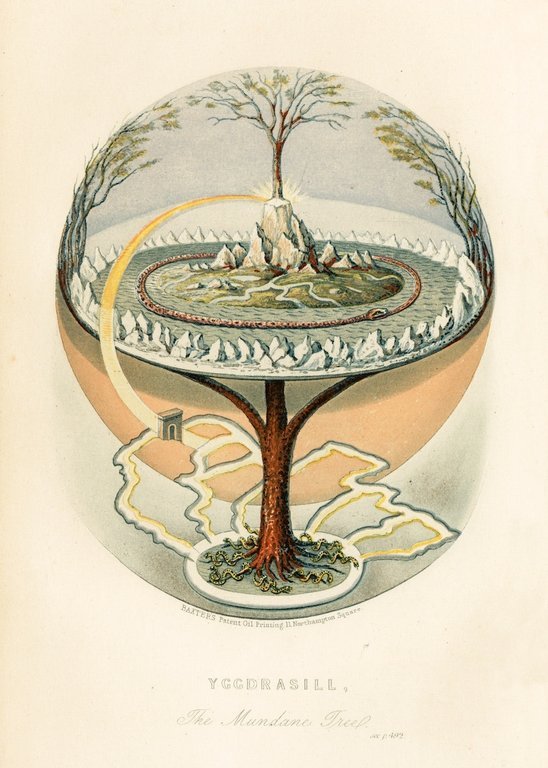
Yggdrasil, The Mundane Tree, an 1847 illustration by Oluf Bagge. A later artistic depiction of the Norse World Tree. Public domain, via Wikimedia Commons. — Oluf Olufsen Bagge, Yggdrasil, The Mundane Tree, plate published in Northern Antiquities (1847), via Wikimedia Commons.

4. Choose the degree of meaning that fits
In Greek mythology the woods are peopled with fauns and satyrs, dryads and hamadryads. The first were spirits or gods of the wood and were represented as goats with the heads of men. The dryads and hamadryads sometimes appeared in the form of peasant girls, shepherdesses, or followers of the hunt. It was thought that they perished when certain trees which had been their abode died or were felled, and upon whose existence theirs depended.
The Romans, whose mythology is based for the most part upon Greek mythology, except that their names for the gods were different, had some special plant gods of their own. Faunus was worshipped as a god of fields and shepherds, and the god Sylvanus presided over forest glades and ploughed fields. Then there was Flora, the goddess of flowers, and Pomona, the goddess of fruit trees, and Vertumnus, the husband of Pomona, the guardian of fruit trees, gardens, and vegetables.
That gives me a range. A tree can hold a whole connected world. It can point to ancestry. It can stand for knowledge. Or it can stay close to one garden and the work of caring for it.
I choose the smallest meaning that feels true. If I choose family, can I see connection in the branches? If I choose steadiness, does the trunk hold my eye? If I choose care, I remember that even Ygdrasil had to be watered each day.
The Amethyst Tree of Life Bracelet is one specimen I can read this way. Its current listing shows purple stone beads around a silver-colored tree charm, with 8 mm beads and an adjustable length. I would choose the meaning before I put it on.
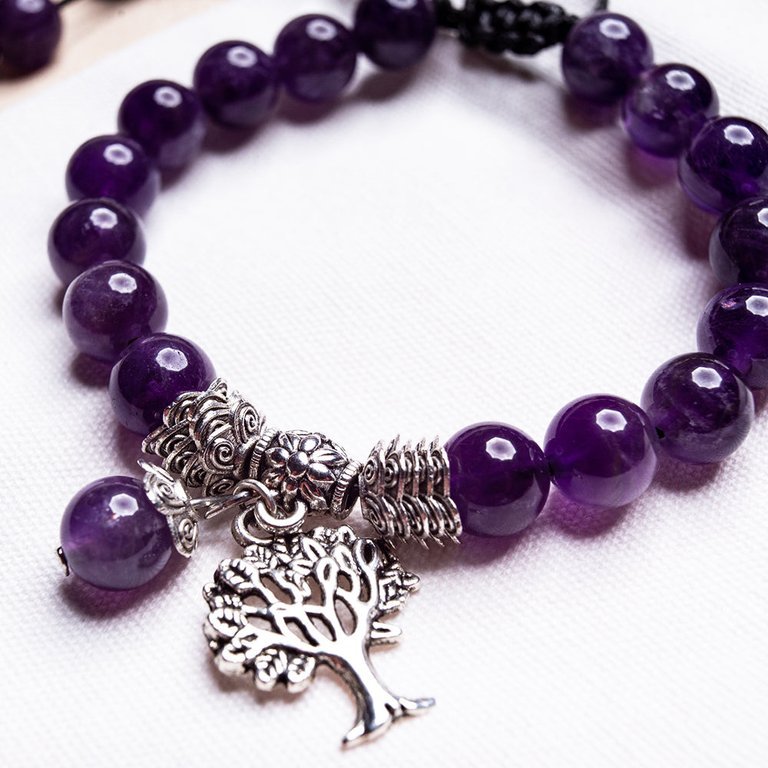
The Amethyst Tree of Life Bracelet shown in the current Karma Items product listing.
Gloria Cardenas
About Gloria Cardenas

Gloria Cardenas lives in South Tucson, in the stucco house she bought in 1988. She strings malas at a card table with a faded beach towel under the beads so they don't roll onto the linoleum. A sitting-group teacher in the late nineties made her count 108 without looking down. She still does it that way. She keeps one finished strand on a nail by the kettle.