
What Are Grounding Sheets? How They Work and Setup Guide
I treat a grounding sheet as a practical object first: conductive bedding corded to verified earth ground. Skin completes the connection; sleep claims are separate.
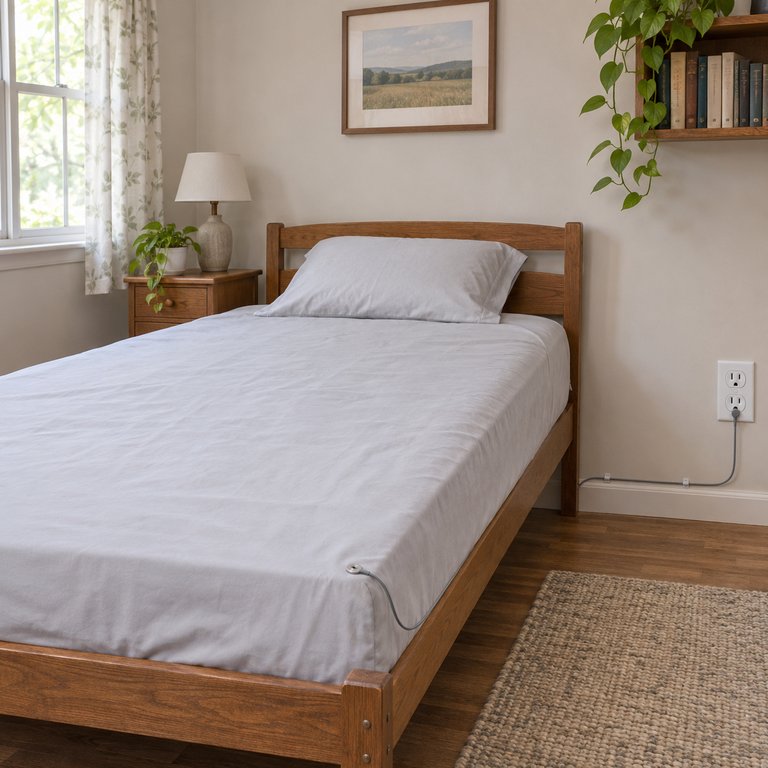
Illustration of a generic grounding-sheet setup. It shows the object and cord path, not a measured health result or the current product.
A snap sits at the mattress edge; its cord runs behind the bed. That is the first thing I look for.
I inspect cloth, ground, and evidence before trusting one changed night. Then I set it up.
What grounding sheets are
Silver or carbon fiber conducts. I check that its cord uses the outlet's ground port, never a live slot.
Every form needs sound ground and skin contact.
How grounding sheets are used
Conductive thread supplies the path. Wash exactly as labeled.
Grids and mixed weaves can conduct; comfort proves nothing electrical.
Do grounding sheets really work?
The electrical job can be tested. I can separate that test from a promise about sleep: conductive cloth joined to earth can lower the body's measured voltage.
Sleep is harder. William A. Hammond's 1869 Sleep and Its Derangements is history, not medical guidance. Its old account shows observation and explanation mixed:
The state of general repose which accompanies sleep is of especial value to the organism in allowing the nutrition of the nervous tissue to go on at a greater rate than its destructive metamorphosis. The same effect is, of course, produced upon the other structures of the body; but this is not of so much importance as regards them, for while we are awake they all obtain a not inconsiderable amount of rest. Even those actions which are most continuous, such as respiration and the pulsation of the heart, have distinct periods of suspension.
Thus, after the contraction and dilatation of the auricles and ventricles of the heart, there is an interval during which the organ is at rest. If we divide the respiratory act into three equal parts, one will be occupied in inspiration, one in expiration, and the other by a period of quiescence. And so with the several glands. Each has its time for rest. And of the voluntary muscles, none, even during our most untiring waking moments, are kept in continued action.
But for the brain there is no rest, except during sleep, and even this condition is, as we all know, only one of comparative quietude in many instances. So long as an individual is awake, there is not a single second of his life during which the brain is altogether inactive; and even while he is deprived by sleep of the power of volition, nearly every other faculty of the mind is capable of being exercised; and several of them, as the imagination and memory, for instance, are sometimes carried to a pitch of exaltation not ordinarily reached by direct and voluntary efforts.
During wakefulness therefore the brain is constantly in action, though this action may be of such a character as not always to make us conscious of its performance. A great deal of the power of the brain is expended in the continuance of functional operations necessary to our well-being. During sleep these are altogether arrested or else very materially retarded in force and frequency.
Many instances of what Dr. Carpenter very happily calls “unconscious cerebration” will suggest themselves to the reader. We frequently find suggestions occurring to us suddenly, suggestions which could only have arisen as the result of a train of ideas passing through our minds, but of which we have been unconscious. This function of the brain continues in sleep, but not with so much force as during wakefulness.
The movements of the heart, of the inspiratory muscles, and of other organs which perform either dynamic or secretory functions are all rendered less active by sleep; and during this condition the nervous system generally obtains the repose which its ceaseless activity during our periods of wakefulness so imperatively demands.
The physiology is old. The durable point is modest: sleep is relative quiet, not a switch that names its own cause.

Cover of Sleep and Its Derangements by William A. Hammond (1869), the historical source quoted in this article. Project Gutenberg eBook 43887; public domain in the United States. — William A. Hammond; Project Gutenberg eBook 43887. Source scan produced from Internet Archive images, as credited in the Gutenberg header.
Hammond then wrote: Authors, in considering sleep, have not always drawn the proper distinction between the exciting and the immediate cause. Thus Macario, in alluding to the alleged causes of sleep, says:
Among physiologists some attribute it to a congestion of blood in the brain; others to a directly opposite cause, that is, to a diminished afflux of blood to this organ; some ascribe it to a loss of nervous fluid, others to a flow of this fluid back to its source; others again find the cause in the cessation of the motion of the cerebral fibers, or rather in a partial motion in these fibers. Here I stop, for I could not, even if I wished, mention all the theories which have prevailed relative to this subject.
Undoubtedly the influence mentioned by Macario, and many others which he might have cited, lead to sleep. They do so through the medium of the nervous system, causing a certain change to take place in the physical condition of the brain. We constantly see instances of this transmission of impressions and the production of palpable effects. Under the influence of fatigue, the countenance becomes pale; through the actions of certain emotions, blushing takes place. When we are anxious or suffering or engaged in intense thought, the perspiration comes out in big drops on our brows; danger makes some men tremble, grief causes tears to flow. Many other examples will suggest themselves to the reader.
It is surely, therefore, no assumption to say that certain mental or physical influences are capable of inducing such an alteration in the state of the brain as necessarily to cause sleep. These influences or exciting causes I propose to consider in detail, after having given my views relative to the condition of the brain which immediately produces sleep.
Later he described wakefulness in the same long form: Every cause capable of increasing the amount of blood ordinarily circulating through the brain may give rise to wakefulness. As these causes are more or less under the control of the individual, it is important that they should be fully considered.
By long-continued or excessive intellectual action, or any powerful emotion of the mind. Every organ of the body, the condition of which admits of being ascertained by ocular examination, invariably contains more blood in its tissues when in a state of activity than when its functions are temporarily suspended.
All of us are familiar with the facts that, during severe mental labor, or while under the influence of some exciting emotion, the vessels of the head and neck become distended, the head feels full, the face is flushed, and the perspiration of the parts in question is increased in quantity.
A moderate degree of cerebral activity is undoubtedly beneficial. Exercise strengthens the mind and improves its faculties, if it is succeeded by a proper period of repose. If, however, the brain is often kept for long periods on the stretch, wakefulness results as a necessary consequence, and every day renders the condition of the individual worse, because time also brings the force of habit into operation.
These old mechanisms are not accepted here as current physiology. They show the problem with using a night of sleep to prove a cause.
Hammond also cautioned against confident sleep reports: It is not to be denied, however, that many individuals are able to live in comparative health for long periods with but little or no sleep. Thus it is stated that Boerhaave did not “close his eyes in sleep for a period of six weeks, in consequence of his brain being overwrought by intense thought on a profound subject of study.” Sir Gilbert Blane says he was informed by General Pichegru, that for a whole year, while engaged in active campaign operations, he slept but one hour out of the twenty-four.
Such statements as these, however, and others to the same effect which have been made, must be accepted with some allowance. Many persons sleep unconsciously, and we all know how common it is for individuals to deny having slept when we have been eye-witnesses of their somnolency. I should consider it impossible for a person to enjoy good health if deprived for even a few weeks of half his ordinary amount of sleep; and it is very probable that Boerhaave's standard of health, never high, was very much lowered by his protracted vigils.
A 2012 review, Earthing: Health Implications of Reconnecting the Human Body to the Earth's Surface Electrons, gathered small early studies about sleep, pain, stress, and other measures. A connected sheet can do its electrical job; strong independent proof of reliable health results is not yet there.
Set up your grounding sheet
I test the outlet first. A fault needs an electrician. I use the ground port only.
Fit it, fasten the snap, connect verified ground, expose skin, and use the supplied tester.
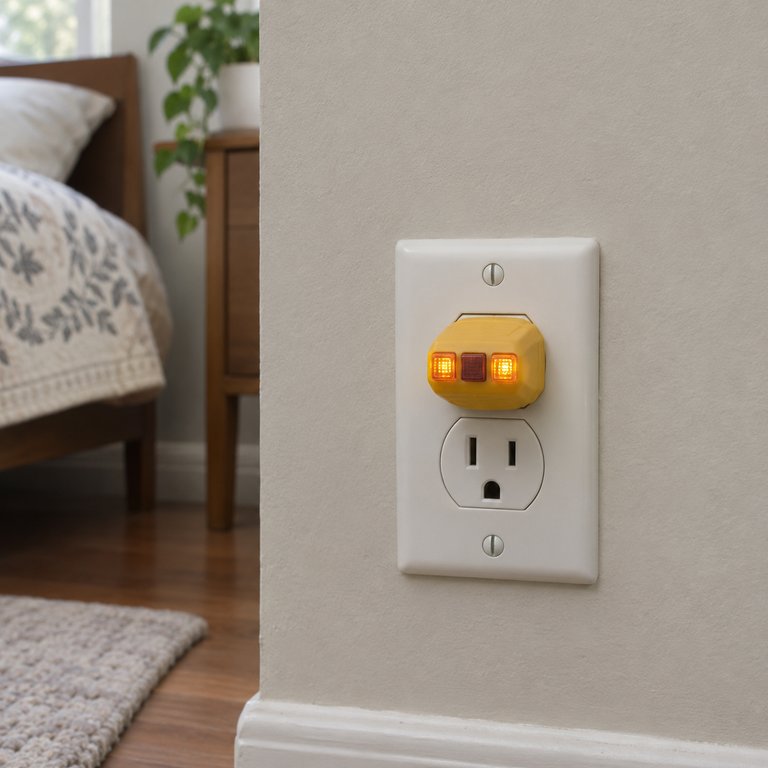
Illustration of checking a grounded outlet before connecting a sheet. Follow the tester and product instructions for the actual setup.
Wash as directed with mild detergent. Avoid bleach and softener unless allowed.
On failure, inspect cord and snap; wash and retest. Replace damage.
Check conductor, size, cord, ground directions, care, and continuity.
Three questions before the first night
Full-body contact? No; one bare patch can connect. Another sheet? Direct contact is clearest. Heat? No; it is not an electric blanket.
The FluxMesh Grounding Bedsheet is one specimen I can check against those rules. It lists 95% cotton and 5% silver fiber, with cord and snap. It requires contact and mild detergent.
Gloria Cardenas

Current Shopify media showing the FluxMesh Grounding Bedsheet with its included grounding cable.
About Gloria Cardenas

Gloria Cardenas lives in South Tucson, in the stucco house she bought in 1988. She strings malas at a card table with a faded beach towel under the beads so they don't roll onto the linoleum. A sitting-group teacher in the late nineties made her count 108 without looking down. She still does it that way. She keeps one finished strand on a nail by the kettle.