
What Is Agarwood? Incense, Malas, and Buying Guide
Agarwood is fragrant, resin-rich wood formed inside certain trees after injury. People burn it as incense and shape it into beads.
At my card table in South Tucson, ordinary wood beads smell mostly of wood and the room. Agarwood can be deeper and sweeter. One owner called it “a deeper, richer smell” than sandalwood. Another said the scent took her “back to another time and place.”
A guide has three jobs here: name the material, show how resin changes it, and give you sensible questions for incense or beads.
We will take the tree first, then the resin, then incense and malas, and finish with the buying questions.
What agarwood is
Agarwood is dark, fragrant, resinous wood produced by several trees, mainly species of Aquilaria and Gyrinops. Healthy wood from these trees is generally pale and light. It may have little scent.
The valued material appears where a tree has responded to damage. Resin gathers in the wood. The grain can grow darker and heavier, and it holds the aroma for which agarwood is known.
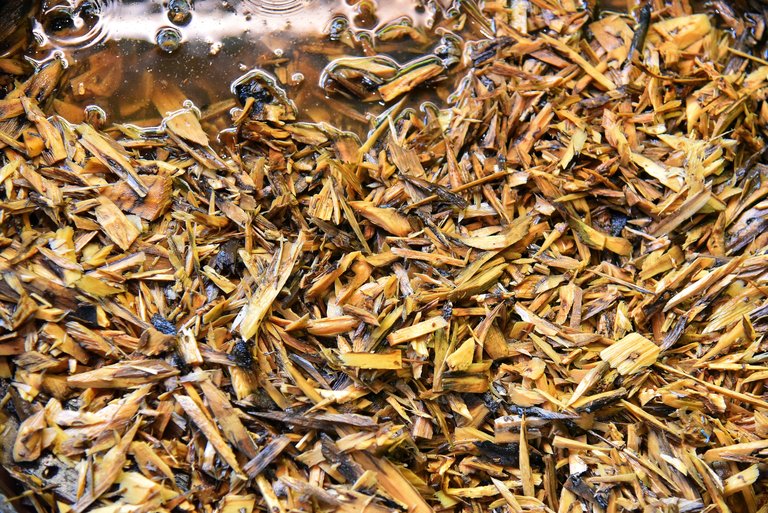
Pieces of Sanchi or Aquilaria malaccensis wood soaking during preparation for oil extraction. Photograph: পাপৰি বৰা, CC BY-SA 4.0, via Wikimedia Commons. — পাপৰি বৰা, scene of soaking Sanchi tree pieces for oil extraction, via Wikimedia Commons.

How the resin forms
A branch breaks, bark is cut, insects enter, or the tree suffers another wound. Microbes may reach the damaged tissue. The tree lays down protective compounds around the affected place.
As the response continues, resin collects through part of the wood. Pale tissue can turn brown or nearly black. It may become denser, and warming it can release a stronger scent.
The change is uneven. One pocket can be rich while the next is light. It may take years. Species, wound, climate, and the individual tree all matter. Age alone does not tell you how much resin a piece contains.
Two beads in one strand need not match exactly. Grain, color, pores, weight, and scent may vary. But dark color alone is not proof of rich resin. Wood may be dyed, oiled, perfumed, or coated. There is no quick home trick that settles species, age, origin, treatment, and resin content at once.
Why agarwood is used as incense
Incense is aromatic material released by heat. A small piece of resinous wood can give off a large scent. Agarwood may smell woody, sweet, smoky, balsamic, or earthy. One piece may differ from another.
Ekai Kawaguchi’s 1909 Three Years in Tibet does not identify every aromatic wood he encountered. It does show how incense worked in public and religious life. Waiting for a grand lama’s return, he wrote:
After a stay of several days at the temple, I was one day thinking of leaving the town, when I was informed that the Grand Lama was expected home presently, so I went out to witness his procession. It must be noted that owing to the absence of roads in Tibet the procession passed through the more beaten parts of the country, which served as roads. On both sides of the route there stood cylindrical posts upon which incense was burnt by the waiting crowds, both sacerdotal and secular, most of whom prostrated themselves on the advent of the cortège.
The second Grand Lama was borne in a palanquin decorated with gold brocades and gorgeous kinds of silk, and was accompanied by about three hundred mounted attendants who, instead of being armed, carried Buddhist utensils. The procession was heralded by the native band, using some kind of wind instruments and drums. The spectacle was so splendid that I congratulated myself on my good fortune in having witnessed it.
At a later prayer service, the incense moved with people:
The prayer service was held in the Tsochen Hall at Sera, and commenced with a long warlike procession. First came the players on lyres, flageolets, drums, and large flutes, followed by men carrying incense-burners. Then came ten nice looking Tibetan boys, still in their teens, all dressed in fine Buddhist robes ornamented with colored Chinese crape, and each burning incense.
Next followed fifty spear-like objects on each side of the road, each surmounted with a movable blade like that of a Chinese spear. These blades had hilt guards, under which hung gold brocade or fine colored Chinese crape, sixteen feet long, thus making the spear twenty-five feet long altogether. The spear, the handle of which was either of gold or gilt, seemed rather heavy, for two strong warrior-priests carried each of them.
The route, smoke, music, and movement belonged together. For agarwood itself, the practical point is simpler: heat releases aroma held in resin. Meaning comes from the practice in which that aroma is used.
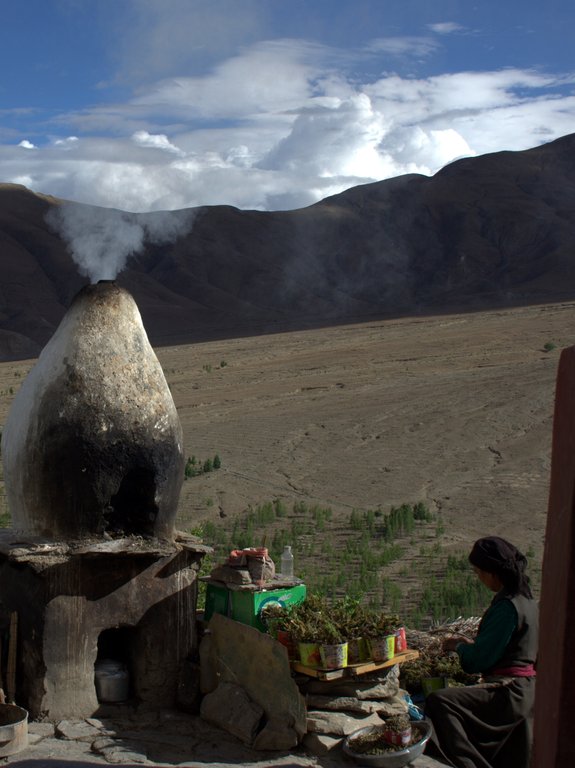
A smoking incense burner and offerings at Yumbu Lakhang in 2010. Photograph: Preston Rhea, CC BY-SA 2.0, via Wikimedia Commons. — Preston Rhea, Buddhist Prayer Implements at Yumbulagang, via Flickr and Wikimedia Commons.

Why agarwood is used in malas
A mala gives repetition a physical shape. One bead passes under the thumb, then the next. The hand keeps count while attention stays with a prayer, name, or breath.
Kawaguchi described beads used even in trade:
Ignorant of arithmetic and possessing no abacus to count with, they have to do all their reckoning with the beads of a rosary. In order to add five and two, they count first five and then two beads on the string, and then count the whole number thus produced to make sure that the total is really seven. It is a very tedious process, but they are incapable of anything better. They cannot do calculations without their beads, and they seem to be too dense to grasp the simplest sum in arithmetic.
Thus business is always slow: when it comes to larger deals, involving several kinds of goods and varying prices, it is almost distractingly complicated. For such calculations they arm themselves with all sorts of aids, black pebbles, white pebbles, bamboo sticks, and white shells. Each white pebble represents a unit of one; when they have counted ten of these they take them away, and substitute a black pebble, which means ten.
His judgment of the people is dated and unfair. The physical fact remains useful: the strand carried a count in the fingers.
He found the same hand knowledge in monastery study:
The catechised sits in a certain attitude, and the questioner stands up with a rosary in his left hand, and walks towards him. He stretches out his hands with the palm of the left hand downwards and that of the right hand upwards and claps them together.
Then the discussion begins in earnest according the rules of the logic of Nyaya. The first question, for instance, may be whether Buddha was human or not. Whether the answer is in the affirmative or the negative, the questioner goes on to ask: “But he was not above mortality, was he?”
Elsewhere Kawaguchi listed the few things in a poor priest’s room. “The poorest priest has in his room a sheep’s fur, a wooden bowl, a rosary and a dirty cushion, which makes a bed at night. In a corner are found a stove, an earthen pan, and a pot or jar, which all belong to the room.” The rosary sat among the ordinary tools of the day.
Wood is light and warm in the hand. Agarwood adds scent. Owners describe that part plainly: “not heavy and very comfortable,” “perfect to wrap around my wrist,” and “handy when I want to repeat my mantra.” Smooth holes and a sound cord still matter more in daily use than a forest legend.
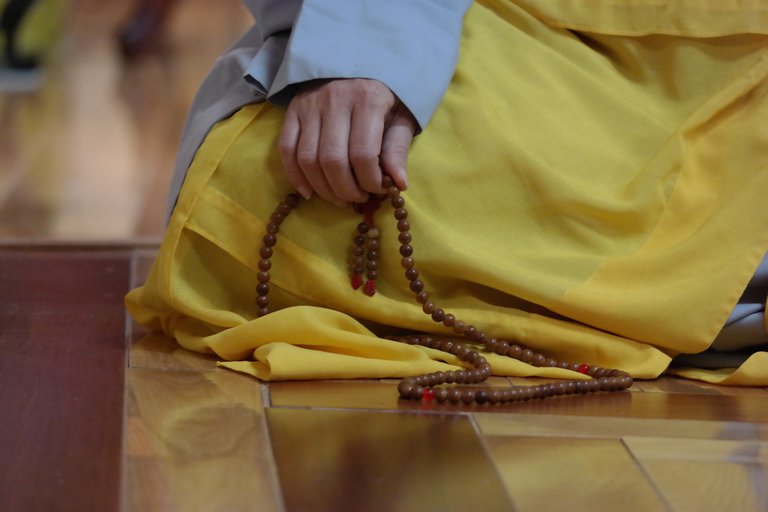
Mala beads held in the hand of a Vietnamese-American Buddhist nun. Photograph: Beelerb, CC BY-SA 3.0, via Wikimedia Commons. — Beelerb, Buddhist mala beads in a nun's hand, via Wikimedia Commons.

Agarwood varies
Color may run from pale tan to deep brown. Resin may show as dark streaks. Aroma may be soft or strong, dry or sweet. Beads may be matte, polished, oiled, or coated. None of these details alone makes a grade.
“Wood of the gods” tells you that people prized the material. It does not prove species, age, origin, or resin content. The same is true of ancient, sacred, wild, and rare. Ask for facts beneath the name.
Buy agarwood wisely
Ask which species the seller believes the wood comes from and where it was grown or obtained. Ask whether it was cultivated, recovered, or wild-harvested. Many agarwood-producing species are covered by international trade controls, so legal sourcing is a fair question.
For beads, look at the whole strand, holes, cord, finishing bead, and knot. Ask whether fragrance, dye, oil, or coating was added. Read the return policy.
Choose for your use. If scent matters, ask whether it is noticeable at room temperature. If you will wear the strand, ask about length and weight. If you will count with it, ask for the bead count.
A long strand may be wrapped around the wrist. Repeated tight wrapping also works the cord, so check for fraying and hard bends.
Kawaguchi’s scenes support incense and counting-strand use in the places he observed. They do not identify every incense wood or the source of any modern bead.
The Old Agarwood Mala is one current specimen. Its listing describes aged agarwood beads, hand-strung construction, and natural aromatic character. The photographs show a long brown wooden strand, a larger finishing bead, and a dark tassel. Owners speak most often about the light feel, wood grain, and deep smell.
The listing gives a material claim and a clear view. If species, origin, treatment, or exact bead count matters to you, ask before choosing it.
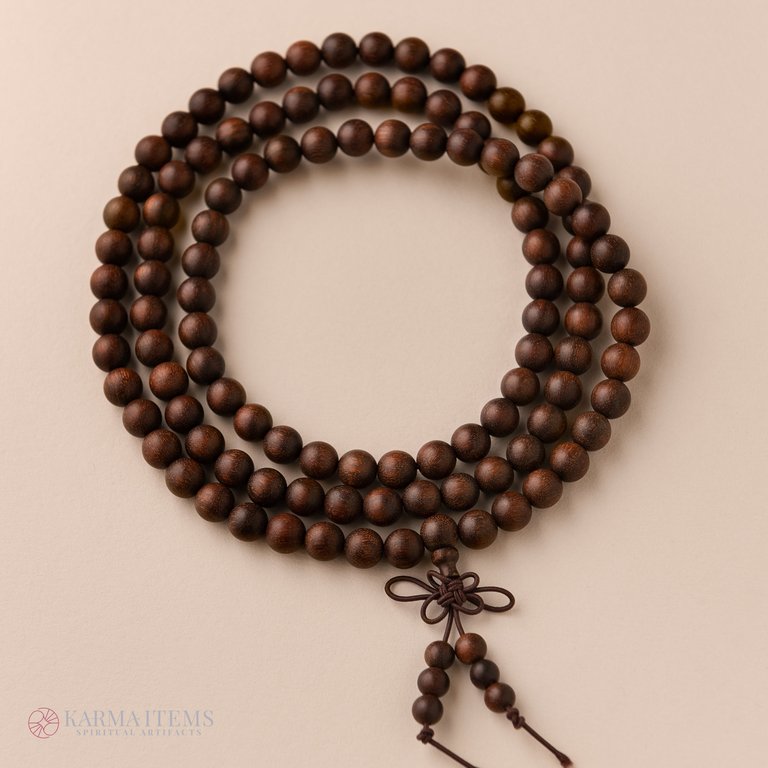
The current Old Agarwood Mala from the Karma Items product listing.
On my faded towel, I look at the holes, the cord, and the grain. Then I listen to the story.
Gloria Cardenas
About Gloria Cardenas
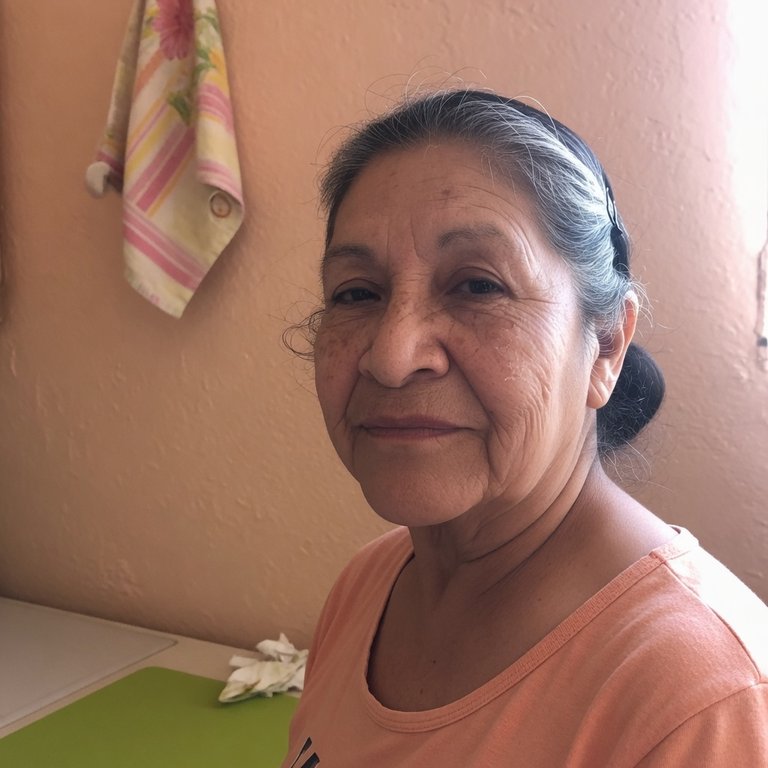
Gloria Cardenas lives in South Tucson, in the stucco house she bought in 1988. She strings malas at a card table with a faded beach towel under the beads so they don't roll onto the linoleum. A sitting-group teacher in the late nineties made her count 108 without looking down. She still does it that way. She keeps one finished strand on a nail by the kettle.