
How to Store Mala Beads Before the Next Use
The short answer: keep the strand by itself, let the cord rest loose and dry, and look it over before you use it again.
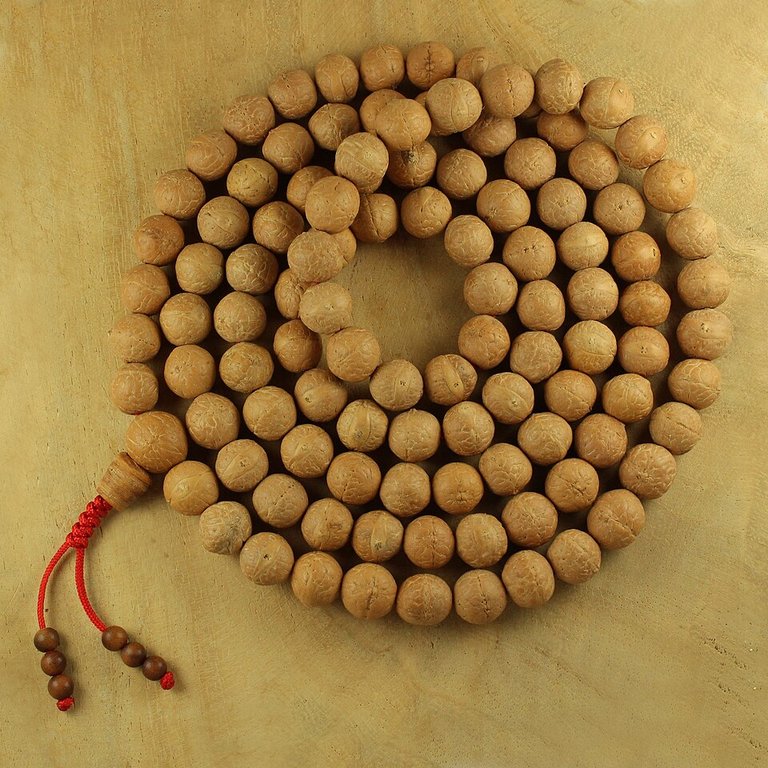
A 108-bead bodhi-seed prayer mala resting in loose coils. Photograph: TibetanMalaShop, CC BY 4.0, via Wikimedia Commons. — TibetanMalaShop, 108 Bodhi Seed Mala Beads (21 October 2017), own work, via Wikimedia Commons.

At my card table in South Tucson, a finished strand stays on the faded beach towel until I know where it is going. Owners have already named ordinary places for it:
> I have My Mala over my Bed such beautiful energy.
> I have an alternative healthcare business promoting self care utilizing such services as Naturopath, Ayurvedic, Reiki, Reflexology and have placed the lapis lazuli in my treatment room.
A bed, a treatment room, a drawer, a travel bag. The place changes. The strand still needs one place of its own. The guide to using a mala covers the counting practice. Storage begins when the beads leave the hand.
1. Separate the strand
Lay out the whole loop. Do not drop it into a drawer with keys, chains, earrings, or metal clasps. A shallow tray, a cloth-lined box, or a soft pouch is enough. Let the strand follow a loose oval or a wide coil. The guru bead and tassel should not be caught beneath the heavier beads.
The Gemological Institute of America gives the same plain rule for jewelry in general: do not toss pieces on a dresser or into a drawer. Separate padded spaces help protect them from scratches and impact. With a mala, separation also means less untangling and less pulling on the cord.
The habit of carrying prayer beads is old, but the way people carried them was not fixed. H. Clifford Smith described European rosaries in Jewellery in 1908:
> Another object which occupied an important position in the Middle Ages and often received special attention at the hands of the goldsmith was the rosary. It was suspended occasionally from the neck, but was more often worn upon the wrist, at the girdle, or attached to a finger ring, and was formed of a string of beads of various sizes and materials representing Aves, Paternosters, and Glorias: each bead receiving the name of the prayer it represented.
Smith's 1381 inventory is more useful if I leave his list in its own words:
> It includes: “4 sets of paternosters of white amber; 16 sets of paternosters of amber; 5 sets of paternosters of coral and geet [jet]; 6 sets of aves of geet, and paternosters of silver-gilt; 38 sets of aves of geet, with gaudees of silver-gilt; 14 sets of aves of blue glass, with paternosters of silver-gilt; 28 sets of paternosters of geet; 15 sets of paternosters of mazer; and 5 sets of paternosters of white bone for children.”
> The makers of these beads were termed paternosterers; and Paternoster Row and Ave Maria Lane were so called from the “turners of beads” who resided there. In Paris, as early as the thirteenth century, the commerce in rosaries was a most flourishing one, and it was customary there to divide the makers or dealers in these articles into three categories—paternosterers of bone and horn, of coral and mother-of-pearl, and of amber and jet.
He also records how the object travelled:
> Among the many forms assumed by mediæval pendants were those of fruits—generally apples or pears. These fruit-shaped pendants, containing either figures or relics, were exceedingly popular. They were carried in the purse or attached to the rosary or to the girdle, or in the case of men, were hung from the neck by a cord or chain; and were constructed so as to be opened during devotions.
The bead string moved between hand, room, and journey. Care has to fit the way it is really carried.
If the beads are dusty, wipe them with a clean soft cloth. If the strand is damp from skin, weather, or cleaning, let it dry before it goes into a pouch. Then look at the full loop once more. Nothing crossed. Nothing pinned beneath it. No harder piece lying on top.
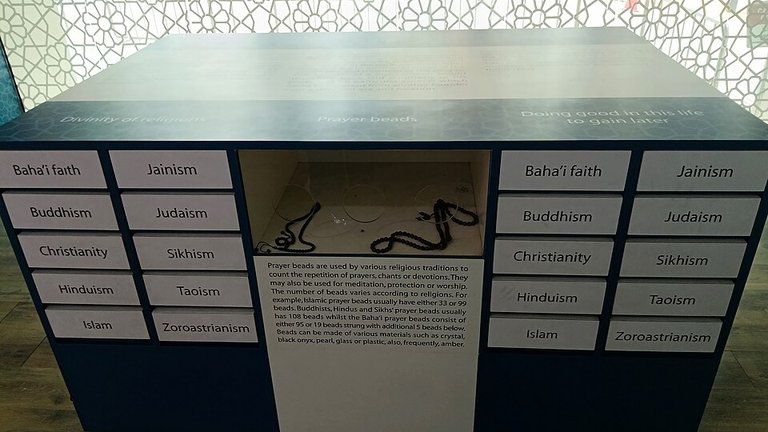
Prayer-bead strands in different materials at Masjid An-Nahdhah's Harmony Centre. This modern exhibit illustrates material variety; it is not the medieval inventory quoted in the text. Photograph: M. Adrian Jurhami, CC BY 4.0, via Wikimedia Commons. — M. Adrian Jurhami, Prayer beads exhibit in the Harmony Centre (28 August 2026), own work, via Wikimedia Commons.

2. Protect the cord
One review gives the inspection better than I can:
> I love this mala. Everything from the beautiful Lapis, the weight, and the craftsmanship. The heavy duty cord that runs through the beads feels as though it may outlast me. The beauty of this mala make it hard to put away. If I were to complain about anything it would be that some of the nazars painted on the marker beads are not well centered. But as this is hand crafted that is to be expected. Beautiful piece. Love it!
Weight, cord, marker beads, hand work. Those are the things to look at. Smith's old account shows that a bead string has never been only one material:
> The larger beads were sometimes of gold, silver, and silver-gilt, of open-work, beautifully chased and engraved, and of boxwood and ivory exquisitely carved. The “gaudees” or “gauds” in the above quotation, the ornaments or trinkets attached to the rosary, were commonly in the form of a crucifix, while the small German charms mentioned above were mostly employed for the same purpose. Of the spherical-shaped gauds or nuts pendent to the rosary, called in French grains de chapelet and known in Germany as Betnüsse, many fine examples exist in boxwood. They have often an open-work case which opens with a hinge, and displays two hemispheres filled with a number of carved figures of minute proportions.
A modern mala has a simpler question. What is carrying all that weight? Run two fingers along the cord without tugging. Look where it enters each bead. Look again beside the guru bead, marker beads, knots, and tassel. If there is a fuzzy patch, a stretched space, or a knot moving out of place, let the strand rest until it can be repaired.
Do not fold the cord sharply to make it fit a little box. Do not shut a lid on the tassel. For a long rest, support the whole loop on a soft level surface instead of asking one narrow hook to carry it.
Hair catches too. One owner put it plainly:
> Love this necklace. It's pretty, feels good, helps me stay present. My hair gets caught on the necklace when I adjust it or take it off, but it's still a great necklace.
Free the hair. Do not pull the strand through it. Keep lotion, perfume, hairspray, cleaner, and wet bathroom air away. GIA notes that ordinary chemicals can harm jewelry materials. The cord should go away clean, loose, and dry.
3. Use a small travel case
Travel removes the mala's usual place. A charger lands on it. The bag goes under a seat. The tassel finds a zipper.
Use a small padded pouch or case, and keep it away from rings, buckles, keys, and hard stone bracelets. GIA advises a separate padded box or case during travel to guard jewelry from scratches and impact.
I keep the pouch in my carry-on. The strand goes in as one loose coil, with the tassel beside it. I run one finger around the edge before closing the zipper. When I open it again, I want to find that same loose curve.
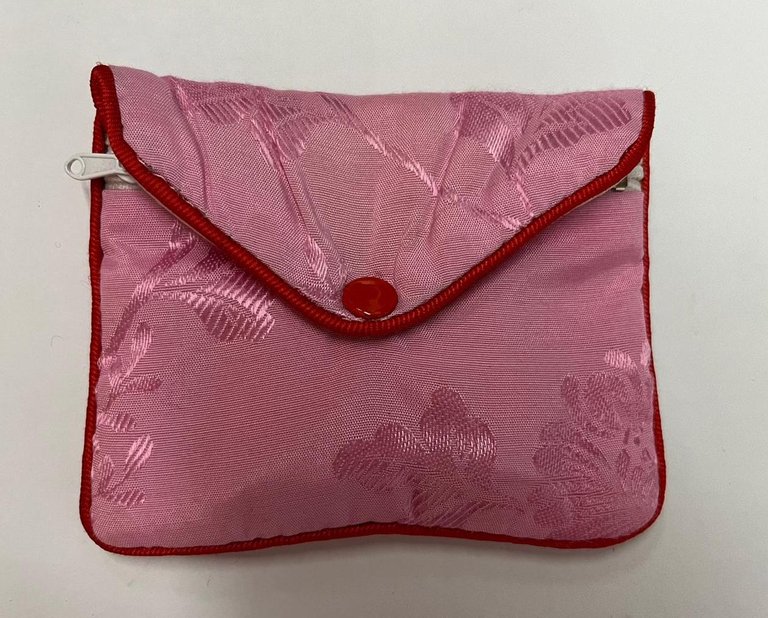
A soft fabric jewellery pouch with a zip pocket and snap closure. Photograph: My Community Sg, CC BY 4.0, via Wikimedia Commons. — My Community Sg, Jewellery pouch containing receipt for gold jewellery bought from Hua Lian Goldsmiths — c. 1970s–1980s, via Wikimedia Commons.

4. Check it before the next use
Pick up the whole strand rather than lifting it by one end. Let some of the weight rest in the other hand. Look for a sudden gap between beads. Feel for a rough place in the cord. Check the holes where the cord bends, then the guru bead, markers, knot, and tassel.
Natural beads do not have to match like plastic buttons. A hand-finished marker may sit a little off center. That is different from a new chip, a sharp edge at a hole, or cord that has begun to fray.
The storage check is small. Is the strand dry? Is it free of tangles? Does the cord look even? If yes, use it. If a bead is cracked at the hole, the cord is fuzzy, or the knot is moving, repair it first.
One strand to apply the method to
These four checks belong to any full mala: one place of its own, a loose and dry cord, a padded travel case, and a quick look before the next round.
For one real specimen, the Lapis Lazuli Third Eye Mala is made with 108 Lapis Lazuli beads. Look at the complete loop before one blue bead. Notice the marker points, the cord between the holes, and where the weight settles. If it comes home with you, choose its resting place before the first time you put it down.
The object waits. The cord rests. Next time, the strand is ready for the hand.
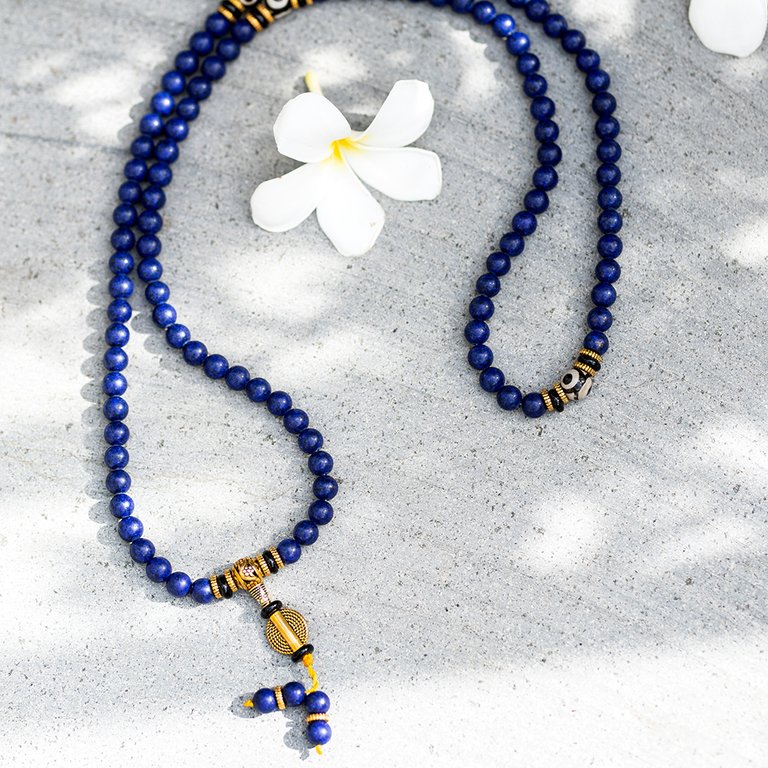
The Lapis Lazuli Third Eye Mala shown in the current Karma Items product listing.
At my card table, finished strands stay on the towel until I know where each one is going. That small pause saves a lot of pulling later.
Gloria Cardenas
About Gloria Cardenas
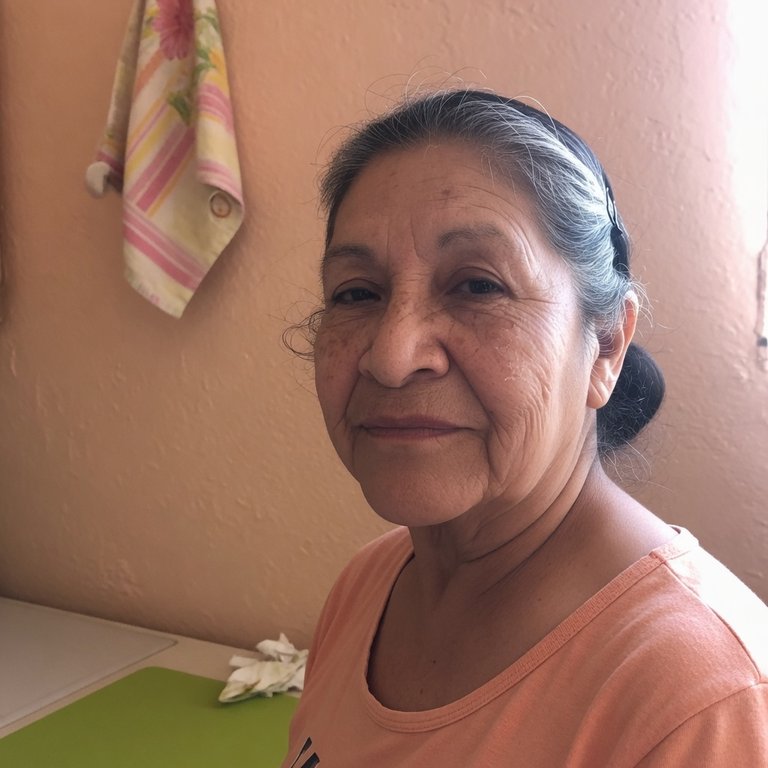
Gloria Cardenas lives in South Tucson, in the stucco house she bought in 1988. She strings malas at a card table with a faded beach towel under the beads so they don't roll onto the linoleum. A sitting-group teacher in the late nineties made her count 108 without looking down. She still does it that way. She keeps one finished strand on a nail by the kettle.