
Citrine vs Amethyst: A Jewelry Lover’s Guide
Violet or yellow: my five jewelry choices begin with quartz.
I start with G. F. Herbert Smith’s 1912 account: amethyst is derived from a Greek word meaning “not drunken,” possibly from a notion that the wearer was exempt from the usual consequences of unrestrained libations. Pliny suggests as an alternative explanation that its colour approximates to, but does not quite reach, that of wine. I keep that as history.
Quartz is the crystallized form of silica, oxide of silicon. When pure, it is entirely devoid of the faintest trace of colour and absolutely water-clear. Such stones are called rock-crystal, and it is easy to understand why in early days it was supposed to represent a form of petrified water. It is these brilliant, transparent stones that are, when small, known in many localities as “diamonds.” Before the manufacture of glass was discovered and brought to perfection, rock-crystal was in considerable use for fashioning into cups, vases, and so forth.
Shared quartz family
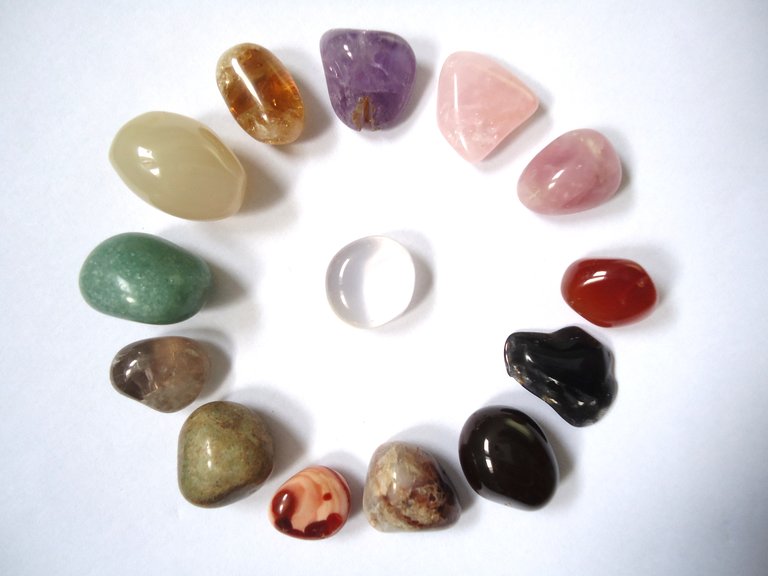
Polished pebbles from the quartz group, including purple and yellow varieties. Photograph: Mauro Cateb, CC BY-SA 3.0, via Wikimedia Commons. — Mauro Cateb, Pebbles of the quartz group, 3 January 2011, via Wikimedia Commons.

For a crystal pendant, I follow Smith’s description of the familiar six-sided prisms terminated by six inclined, often triangular, faces; twins are common, though they are not always obvious from the outward development. My round beads are quartz too.
I look more closely at his faceted stone. In accordance with the symmetry the refraction is double, and there is one direction of single refraction, namely, that parallel to the edge of the prism. The ordinary refractive index has the value 1.544, and the extraordinary 1.553, and since the latter is the greater, the sign of the double refraction is positive. The double refraction is small in amount, but is large enough to enable the apparent doubling of certain of the opposite edges of a faceted stone to be perceptible when viewed with a lens through the table-facet. I take this as an explanation of a doubled edge. Quartz has only about the same amount of colour dispersion as ordinary glass, and lacks, therefore, “fire.”
I find his broad comparison useful: although the commonest and, in its natural form, the most easily recognizable of mineral substances, quartz nevertheless holds a not inconspicuous position among gem-stones, because, as amethyst, it provides stones of the finest violet colour. For all purposes where a violet or yellow stone is required, quartz is admirably suited; it is hard and durable. Despite its comparative lack of “fire,” rock-crystal might replace paste in rings and buckles with considerable advantage from the point of view of durability. Paste is imitation glass.
Colour
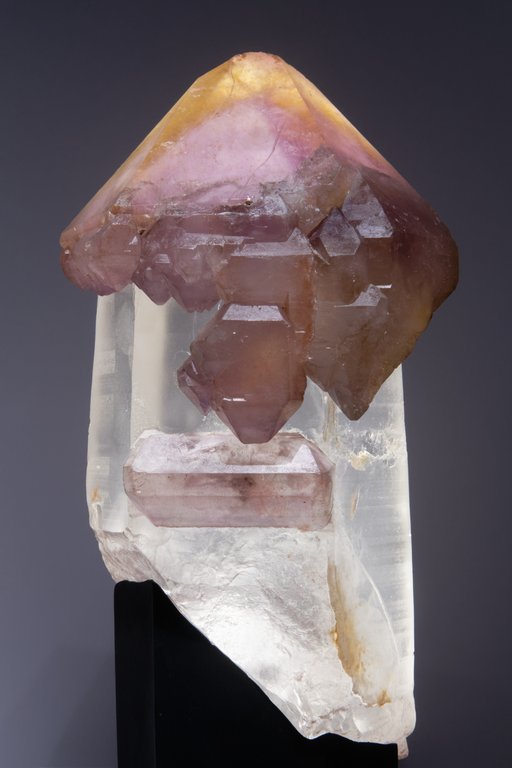
Clear prismatic quartz, amethyst, and citrine in one specimen from Mangataboahangy, Madagascar. Photograph: Marie-Lan Taÿ Pamart, CC BY 4.0, via Wikimedia Commons. — Marie-Lan Taÿ Pamart (Jastrow), quartz specimen from Mangataboahangy at the French National Museum of Natural History, 30 January 2020, via Wikimedia Commons.

I picture a dress brooch on everyday linen. Smith describes the purple or violet colour of amethyst, which varies considerably in depth. Jewellers were inclined to distinguish the deep-coloured stones with the prefix “oriental,” but the practice was to be deprecated, since it might lead to confusion with the true oriental amethyst, a purple sapphire, one of the rarest varieties of corundum. For a modern example, the guide to amethyst tree jewelry shows violet stone set into a branching design.
I distinguish colour from interior appearance. Stones of a smoky brown colour are known as smoky-quartz. In milky quartz, as the name suggests, the interior is so hazy as to impart to the stone a milky appearance. It has frequently happened that quartz has crystallized after the formation of other minerals, with the result that the latter are found inside it. Specimens containing hair-like fibres of rutile are common in mineral collections, and are sometimes to be seen worked.
For yellow, I use GIA: citrine is transparent quartz, pale yellow to brownish orange. I like either against linen.
Treatments
For yellow or purple beads, I ask about treatment. Smith observed that the application of strong heat tends to weaken or drive off the colour. Thus the dense smoky-quartz found in Spain, Brazil, and elsewhere is converted into stones of a colour varying from light yellow to reddish brown according to the amount and duration of the application. In the case of amethyst the colour is changed to a deep orange, or entirely driven off if the temperature be high enough.
GIA says most market citrine results from heating amethyst, not all. I choose colour; I ask for treatment disclosure.
I also notice Smith’s internal patterns. Amethyst is composed of separate twin individuals, alternately right- and left-handed; in some remarkable crystals the section at right angles to the prism edge is composed of triangular sectors, alternately of different hands and of different tints, purple and white. To the twinning he attributed the rippled fracture and the feathery inclusions so characteristic of amethyst. These patterns do not disclose treatment.
Care and personal preference
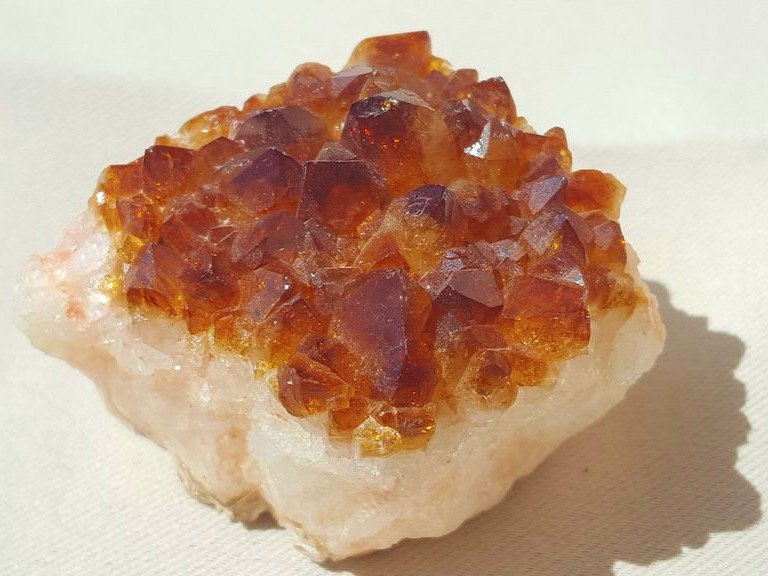
Amethyst changed to an orange colour by heat treatment; the source identifies this specimen as not natural citrine. Photograph: Jennifer A. Hogan, CC BY-SA 4.0, via Wikimedia Commons. — Jennifer A. Hogan, heat-treated amethyst specimen from New Hampshire, 17 January 2021, via Wikimedia Commons.

For a cracked pendant, I note Smith’s rainbow-quartz, or iris: a quartz which contains cracks, the chromatic effect being the result of the interference of light reflected from them. It has been artificially produced by heating the stone and suddenly cooling it.
To quartz has been assigned the number 7 on Mohs’s scale of hardness. I still avoid heat. GIA’s care advice is warm soapy water for both stones; abrupt temperature changes may fracture either. Prolonged intense light can fade some amethyst. I avoid steam and heat, and check care for the whole setting or strand.
For an older yellow jewel, I return to Smith’s names. The yellow quartz so ably vies with the true topaz that it was known to jewellers by the name of the latter species, and too often confounded with it. Quartz of a yellow hue is properly called citrine, but jewellers habitually preferred the name “topaz” for it, and distinguished the true topaz by the prefix Brazilian, not a very happy term, since both the yellow topaz and the yellow quartz occur plentifully in Brazil. Sometimes the yellow quartz was termed occidental, Spanish, or false topaz. Stones with a brownish or smoky tinge of yellow were called cairngorm, or Scotch topaz.
I choose colour after confirming material and treatment.
I would consider the Citrine Mala of Financial Blessings for its yellow beads beside three lapis lazuli beads. The listing describes natural citrine, 8mm beads and about 34 inches, or 86cm, of length. Treatment status is undisclosed; I would not read “natural” as “untreated.”
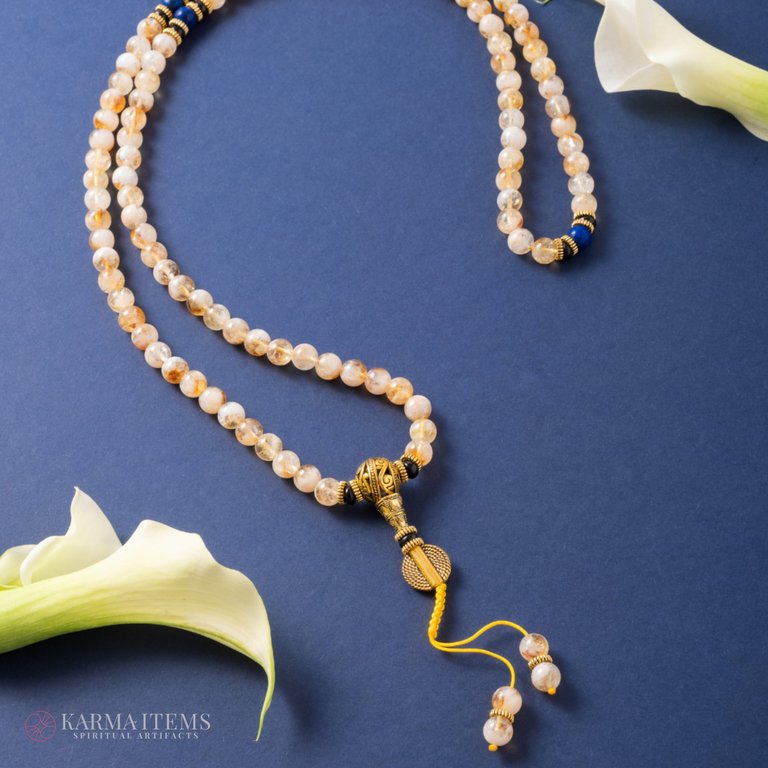
The Citrine Mala of Financial Blessings shown in the current Karma Items product listing.
I work in my dining room in Kettering, Ohio.
Michele Bruns
About Michele Bruns

Michele Bruns works out of the dining room of a brick ranch in Kettering, Ohio. After the last child left she bought a folding table, a sheet of linen, and a weekend reflexology certificate in Dayton. She puts one object on the sideboard and leaves it while people come and go. If you ask, she will tell you where she put it. She will not give a speech.