
How to Clean Amethyst Jewelry Without Heat or Scratches
Warm soapy water is the short answer. Check the workmanship before the washing begins.
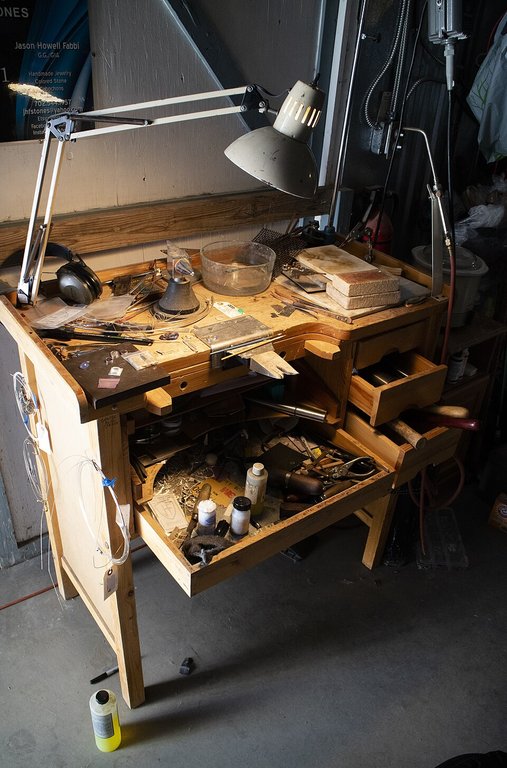
A jeweler's workbench for making and inspecting settings, clasps and other small parts. Photograph: Thomas Farley, CC0, via Wikimedia Commons. — Thomas Farley, Jeweler's Workbench (26 April 2019), via Wikimedia Commons.

There are many misconceptions as to the care and the cleaning of jewels. And there is but one sound rule. When jewelry needs to be cleaned, take it to the jeweler.
That was Marianne Ostier's rule in 1958. It is more cautious than the Gemological Institute of America's current advice that amethyst can be safely cleaned with warm soapy water. I keep her order: examine the workmanship first. A doubtful piece goes to the jeweler; a sound one can be cleaned at home.
There is one way in which a person can help to keep jewelry clean. Every time that a jewel is worn, it should be wiped with clean tissue paper, or chamois leather, before being put away. Facial tissue should not be used, as it will leave a fuzz. Such a gentle wiping will remove the grease of finger-marks, and other marks or specks.
I use a clean lint-free cloth. Amethyst rates 7 on the Mohs scale and has good toughness. That number belongs to the stone, not to the thread, clasp, glue, coating, or mounting. The guide to the details of amethyst tree jewelry covers the material and design. Here the minimum rule is simpler: look at the complete piece before it gets wet.
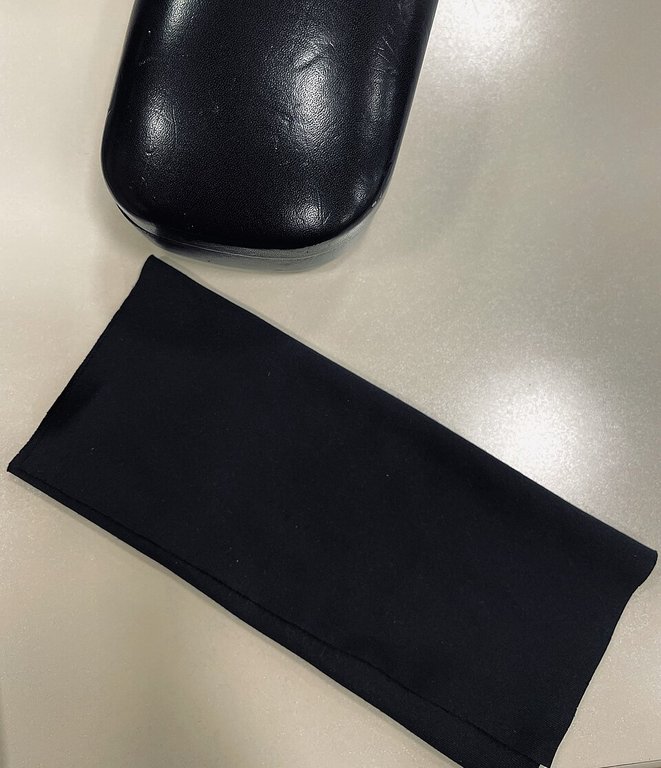
A folded cleaning cloth beside its case. The source identifies it as a microfiber eyeglass cloth. Photograph: BeVegan22, CC BY-SA 4.0, via Wikimedia Commons. — BeVegan22, Microfiber cloth (19 October 2022), own work, via Wikimedia Commons.

1. Check the setting, string, and clasp
A woman who takes her jewels to a jeweler, to have him clean them, is showing that she regards him as her regular dealer; as such, he will be happy to clean them without charge. At the same time, he will check the settings, the clasps, the safety catches. While home cleaning might damage a stone, or loosen it in its setting, professional work restores the jewel so that it is both cleaner and more secure than before.
The dealer-and-customer wording belongs to 1958. The inspection does not. I put the piece on a folded towel in good light and look for a moving prong, cracked bead, lifting glued part, frayed cord, or clasp that does not close. If a stone moves or the cord has begun to fray, I stop. There is little sense in waiting until it breaks.
2. Use warm water, mild soap, and a soft cloth
GIA's method is warm soapy water. I use a bowl of warm water, a drop of mild dish soap, and a soft lint-free cloth. A strung piece gets a damp cloth rather than a soaking.
In general, it is inadvisable to use a brush for cleaning jewelry, as it tends to loosen the stones. Eventually—not while being cleaned, but during an otherwise pleasant evening—a stone may fall from the setting.
Common substances like sand and dust are composed mostly of quartz, the mineral species that includes the purple variety amethyst. So, while amethyst is a great gemstone for use in jewelry, it should be treated with the proper care to prevent scratching and other damage. If the cloth picks up grit, I rinse it or change it.
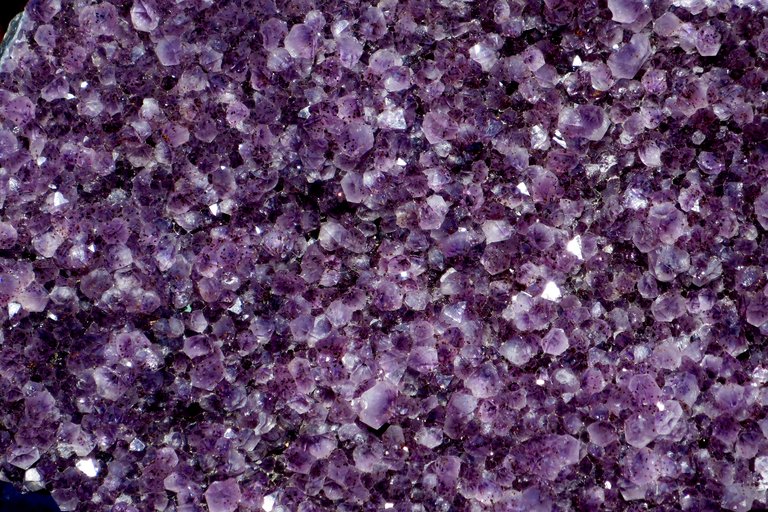
Natural amethyst crystals, the purple variety of quartz. Photograph: Lisa Ann Yount, CC0, via Wikimedia Commons. — Lisa Ann Yount, Amethyst crystals close (1 May 2014), via Wikimedia Commons / Flickr.

3. Remove the soap and let the piece dry
Ammonia, soap, and other cleaning agents are likely to leave a film. This may be imperceptible; a person may think it has all been cleaned off, and yet it may greatly lessen the brilliance of the stone.
I take off the soap with a second cloth dampened with clean water. A strung piece does not go under a strong faucet.
For casual cleaning, a strung jewel may be wiped with a clean and slightly damp cloth. It should not be pulled; the best way is to roll it on a towel. If the piece becomes too wet, the string may become loosened. A necklace should be regularly restrung; there is little sense in waiting until it breaks. That old passage concerns pearls. Its warning about wet string is still useful here. I blot the piece with a dry lint-free cloth and lay it flat on a clean towel. Bracelets and necklaces should not be forced out of shape by rolling or bending, lest the stones be pressed out of their settings.
4. Avoid steam, sudden heat, and hard scrubbing
Soaking in boiling water, with or without chemicals, is dangerous. Some alloys as well as some stones cannot stand such treatment. Likewise sudden heat, or sudden cooling, may seriously damage certain stones; some may even crack or break.
GIA makes the amethyst warning exact. Abrupt temperature changes can cause amethyst to fracture. Some amethyst color can fade with prolonged exposure to intense light. Steam cleaning is not recommended, and amethyst should not be subjected to heat.
I use no steam wand, boiling water, hair dryer, abrasive powder, or stiff brush. Ultrasonic cleaners are usually safe except in the rare instances where a stone is dyed or treated by fracture filling. An unknown treatment or construction goes back under the first rule: ask the jeweler.
Jewels should be kept apart, so as not to scratch one another. Hard gems might, for instance, injure the skin of pearls. The hardest of all, the diamond, must be carefully wrapped so that it will not scratch other stones.
Individual pouches can accommodate the various jewels. Ostier described a pouch made of suede leather and lined with chamois. It contained partitions that comfortably held the various types of jewel: bracelets, earclips, clips, rings, necklaces, and the rest. Bracelets and necklaces, of course, should not be forced out of shape by rolling or bending, lest the stones be pressed out of their settings.
The chamois was designed to keep the jewels apart, so as not to scratch one another. Long experience traveling with many jewels, both of her professional and personal collection, enabled Ostier to fashion a pouch that combined practicality with good looks. The same arrangement can be much plainer. A small cloth pouch or a separate space in a jewelry box is enough. The important part is that the dry amethyst does not rub against harder stones or catch its cord on a clasp.
One bracelet, checked by the same routine
The Amethyst Tree of Life Bracelet has 8 mm beads and an adjustable length. The photographs show purple beads, silver-colored spacers, a tree charm, and cord. I inspect the cord, wipe the beads with a damp soapy cloth, take off the soap with a second cloth, and leave the bracelet flat until dry.
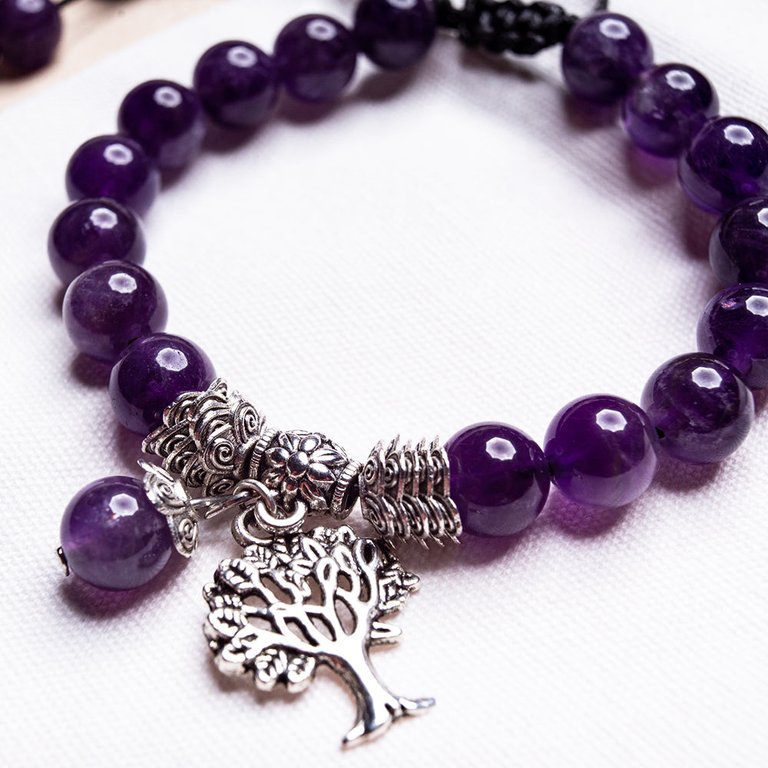
The Amethyst Tree of Life Bracelet shown in the current Karma Items product listing.
From my folding table in Gresham, Oregon,
Craig Lembke
About Craig Lembke

Craig Lembke lives in Gresham, Oregon. He spent twenty-three years speccing rooftop HVAC units, then set a folding table up in the garage when the company thinned out. A resin-and-metal pyramid sits next to the laptop. He found Wilhelm Reich in a library remainder stack and still cannot tell you how much of it is solid. He wants the object explained without a speech.