
Amethyst Colour Differences: How to Choose a Shade
At my folding table in Gresham, I check how pale, how dark, how even, and under which light. Two beads may part company beside a window.
The wider guide to the details in an amethyst tree of life bracelet covers the object. Here I am staying with the colour.
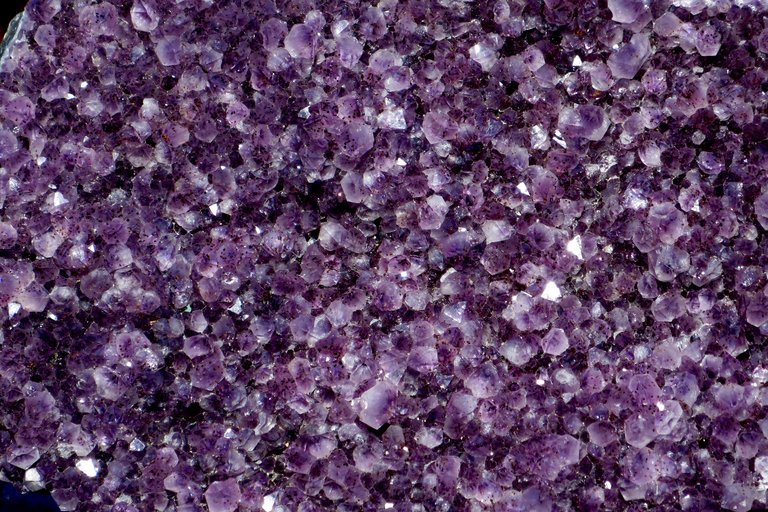
Natural amethyst crystal faces in several violet depths. Photograph: Lisa Ann Yount, CC0, via Wikimedia Commons. — Lisa Ann Yount, Amethyst crystals close (1 May 2014), via Wikimedia Commons / Flickr.

Purple ranges
C. J. Spencer began Gem-Stones and Their Distinctive Characters this way: “Beauty, durability, and rarity: such are the three cardinal virtues of a perfect gem-stone.” Stones lacking any of them cannot aspire to a high place in the ranks of precious stones, although it does not necessarily follow that they are of no use for ornamental purposes.
That a gem-stone should be a delight to the eye is a truism that need not be laboured; for such is its whole raison d’être. The members of the Mineral Kingdom that find service in jewellery may be divided into three groups, according as they are transparent, translucent, or opaque. Of these the first, which is by far the largest and the most important, may itself be further sub-divided into two sections: stones which are devoid of colour, and stones which are tinted.
A coloured stone, on the other hand, depends for its attractiveness more upon its intrinsic hue than upon the manner of its cutting. The tint must not be too light or too dark in shade: a stone that has barely any colour has little interest, and one which is too dark appears almost opaque and black. The lapidary can to some extent remedy these defects by cutting the former deep and the latter shallow.
Although the commonest and, in its natural form, the most easily recognizable of mineral substances, quartz nevertheless holds a not inconspicuous position among gem-stones, because, as amethyst, it provides stones of the finest violet colour. For all purposes where a violet or yellow stone is required, quartz is admirably suited; it is hard and durable. Except that cat’s-eye is cut en cabochon, quartz is step- or sometimes brilliant-cut.
When pure, it is entirely devoid of the faintest trace of colour and absolutely water-clear. Such stones are called rock-crystal, and it is easy to understand why in early days it was supposed to represent a form of petrified water. The beautiful tints characterizing quartz are due to the usual metallic oxides. The superb purple or violet colour of amethyst varies considerably in depth.
GIA's current quality guide says: “The finest amethyst color is a strong reddish purple or purple with no visible color zoning. Dealers prefer strongly saturated reddish purple to dark purple, as long as the stone is not so dark that it reduces brightness.” The trade has an ideal; the person wearing the stone still has a preference.
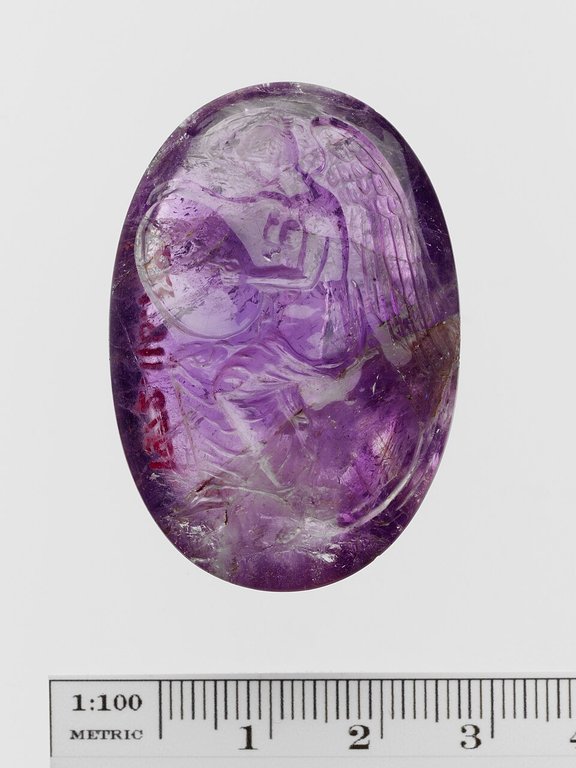
An ancient oval amethyst intaglio of Nike under one fixed museum exposure; a metric scale appears at the foot of the frame. Metropolitan Museum of Art, Open Access / CC0, via Wikimedia Commons. — Metropolitan Museum of Art, Greek or Roman amethyst intaglio of Nike, 1st century B.C.-1st century A.D.; Open Access image via Wikimedia Commons.

Lighting
No hint of colour, save perhaps a trace of the blue of steel, can be tolerated in colourless stones. A coloured stone is another matter. Its tint must not be too light or too dark. The apparent darkness of a deep-coloured stone follows because the light passing into the stone is wholly absorbed within it; since none is emitted, the stone appears black.
In certain curious stones the transparency, and in others the colour, varies considerably in different directions. The colours that are most admired are pure tints, and the absorption spectra corresponding to them are on the whole continuous and often restricted. They therefore retain the purity of their colour even in artificial light, though certain sapphires transmit a relatively larger amount of red, and consequently turn purple at night.
That last example is not a promise that amethyst changes colour. It is a reminder that light and direction take part in what the eye receives.
The double refraction is small in amount, but is large enough to enable the apparent doubling of certain of the opposite edges of a faceted stone to be perceptible when viewed with a lens through the table-facet. The dichroism of the deep-coloured stones is quite distinct. Quartz has only about the same amount of colour dispersion as ordinary glass, and lacks, therefore, “fire.”
GIA says, “If the color is too dark, an amethyst might look black under dim lighting conditions.” Buyers of loose amethysts view color zoning by placing the gems table-down against a white background. I look first in indirect daylight and then in ordinary room light. Online, I compare similar light, background, and distance.
Natural variation
Quartz belongs to the hexagonal system of crystalline symmetry and crystallizes in familiar six-sided prisms terminated by six inclined, often triangular, faces. Twins are common, though they are not always obvious from the outward development.
Amethyst is, in fact, composed of separate twin individuals, alternately right- and left-handed. In some remarkable crystals the section at right angles to the prism edge is composed of triangular sectors, alternately of different hands and of different tints, purple and white. To the twinning is due the rippled fracture and the feathery inclusions so characteristic of amethyst.
In milky quartz, as the name suggests, the interior is so hazy as to impart to the stone a milky appearance. It has frequently happened that quartz has crystallized after the formation of other minerals, with the result that the latter are found inside it. Specimens containing hair-like fibres of rutile are common in mineral collections, and are sometimes to be seen worked. Quartz which contains scales of mica, hematite, or other flaky mineral has a vivid spangled appearance, and is known as aventurine.
GIA notes: “Many amethysts display a weak, light color or have strong zones of lighter and darker purple color.” It says color zoning is most visible when a faceted amethyst is viewed face-down through its pavilion on a white background. A bead offers no table and pavilion, but I can still turn it and watch the purple move. Natural variation is not damage; a fresh chip or broken fitting is another matter.
Beautiful, brilliant, and limpid rock-crystal is found in various parts of the world: in the Swiss Alps, in the famous Carrara marble, in Hungary, and in the United States, Brazil, Madagascar, and Japan. The finest amethysts come from Brazil—especially the State of Rio Grande do Sul—and from Uruguay, India, and the gem-gravels of Ceylon; good stones also occur at Ekaterinburg, in the Ural Mountains.
A splendid Brazilian amethyst, weighing 334 carats, and two Russian stones—one hexagonal in contour, weighing 88 carats, and the other, a deep purple in colour with a circular table, weighing 73 carats—are exhibited in the British Museum (Natural History). I would not assign a finished bead to any of those places by colour alone.
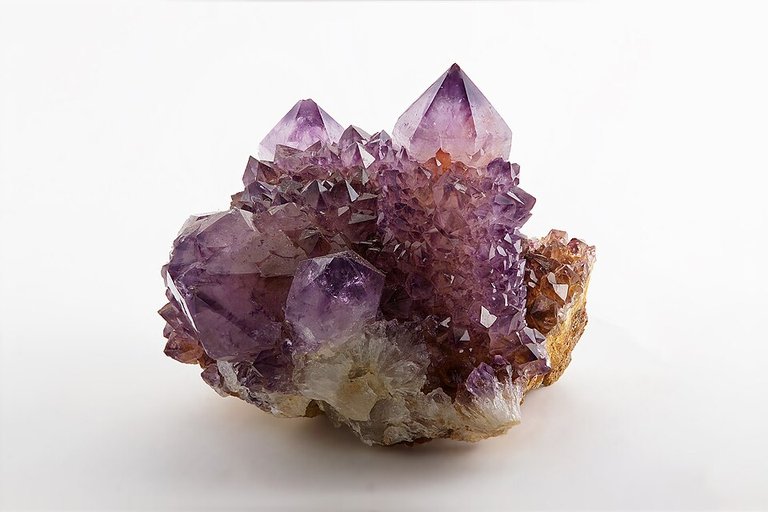
Amethyst from Magaliesburg, South Africa, with pale and deep violet areas in one specimen. Photograph: JJ Harrison, CC BY-SA 3.0, via Wikimedia Commons. — JJ Harrison, Amethyst specimen from Magaliesburg South Africa (18 July 2009), via Wikimedia Commons.

Choosing a shade
A careful study of the showcases of the most extensive jewellery establishment brings to light the fact that, despite the apparent profusion, the number of different species represented is restricted. Diamond, ruby, emerald, sapphire, pearl, opal, turquoise, topaz, amethyst are all that are ordinarily asked for.
A lesser known stone may suddenly spring into prominence owing to the caprice of fashion or the preference of some great lady or leader of fashion. Not many years ago, for instance, violet was the favourite colour for ladies’ dresses, and consequently amethysts were much worn to match, but with the change of fashion they speedily sank to their former obscurity.
Except that diamond, ruby, emerald, and sapphire, and, we should add, pearl, may indisputably be considered to occupy the first rank, it is impossible to form the gem-stones in any strict order. Every generation sees some change. The value of a stone is after all merely what it will fetch in the open market, and its artistic merits may be a matter of opinion. The familiar aphorism, de gustibus non est disputandum, is a warning not to enlarge upon this point.
I use four checks. I name the range I like: pale violet, middle purple, deep purple, or reddish purple. I look for brightness so that a dark stone does not close up in ordinary light. I decide how much zoning or bead-to-bead change I enjoy. Then I compare the whole strand, not one enlarged bead.
Transparent, translucent, and opaque materials handle light differently. In a polished amethyst bead I look at how far light seems to enter, where it returns, and whether the purple remains visible beside a window and at my desk. The strongest reddish purple may be the trade ideal. A quieter lavender may be the one a person chooses.
The current Amethyst Tree of Life Bracelet shows a natural-purple strand around a silver-coloured tree charm. Its listing gives 8 mm beads and an adjustable length. I would open all four product photographs, compare the strand from one view to the next, and choose only if that purple still looks like mine.
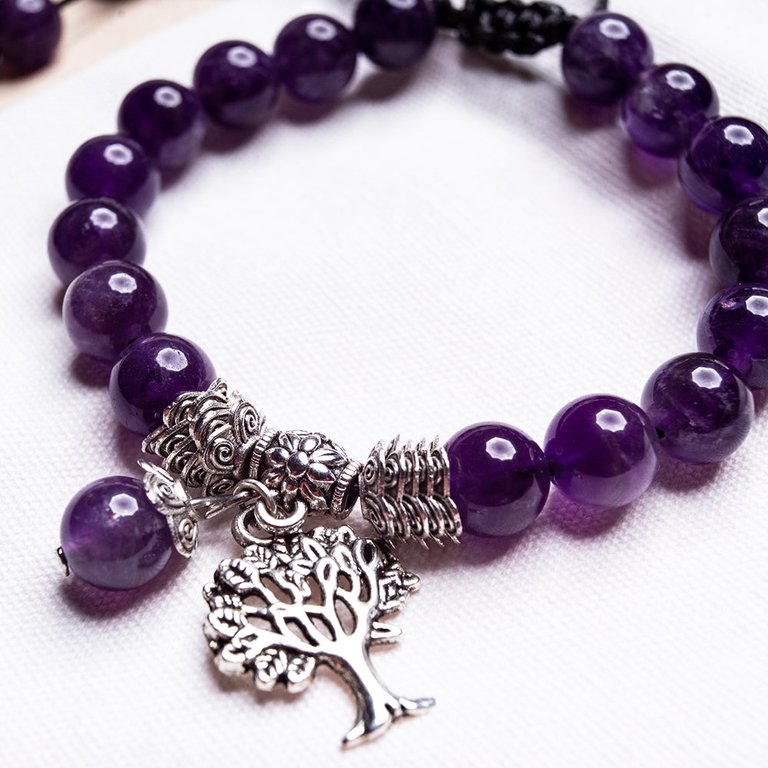
The current Amethyst Tree of Life Bracelet from the Karma Items product listing.
Craig Lembke
About Craig Lembke

Craig Lembke lives in Gresham, Oregon. He spent twenty-three years speccing rooftop HVAC units, then set a folding table up in the garage when the company thinned out. A resin-and-metal pyramid sits next to the laptop. He found Wilhelm Reich in a library remainder stack and still cannot tell you how much of it is solid. He wants the object explained without a speech.