
Labradorite Jewelry Care: Cleaning and Storage Guide
A short routine protects the stone and whatever holds it.
At my folding table in Gresham, the gray stone shows blue at the garage door. Dust shows too.
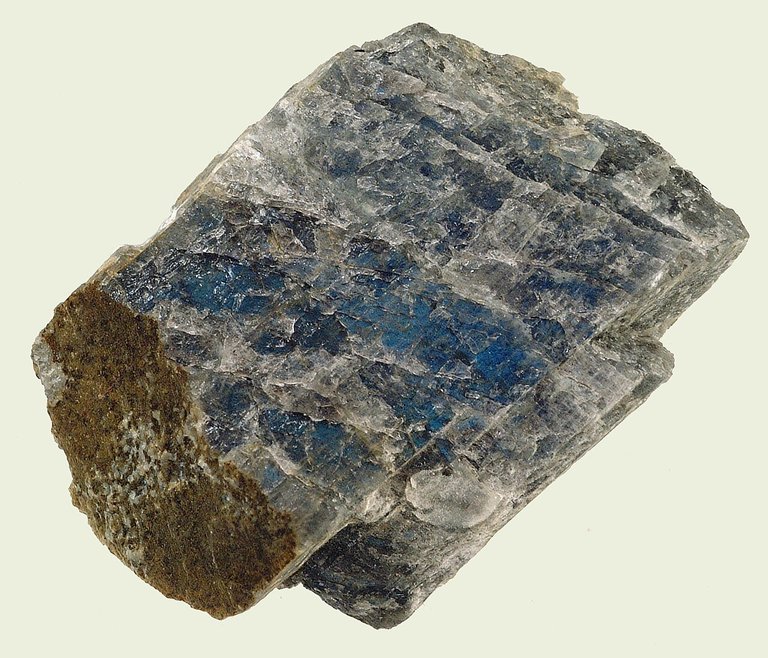
Natural labradorite with gray body color and blue-green iridescence. Photograph: Darla Sondrol, CC0, via Wikimedia Commons. — Darla Sondrol, Labradorite GeoDIL number 2380, via Wikimedia Commons and the Digital Atlas of Ancient Life.

No polishing project: look, wipe lightly, and give it one place.
The amethyst tree of life bracelet guide reads another colored stone. Here the job is care.
Ready for the bench card?
At a glance: inspect, wipe with a clean soft cloth, avoid harsh treatment, and store separately.
You will need:
- A clean, soft, lint-free cloth
- A padded work surface
- A soft pouch or lined compartment
- Side light for checking the setting
Frank Bertram Wade's 1918 A Text-Book of Precious Stones for Jewelers and the Gem-Loving Public supplies the hardness and wear background.
Another property by means of which one may distinguish the various gems from each other is hardness. By hardness is meant the ability to resist scratching. The term “hardness” should not be taken to include toughness, yet it is frequently so understood by the public. Most hard stones are more or less brittle and would shatter if struck a sharp blow. Other hard stones have a pronounced cleavage and split easily in certain directions. True hardness, then, implies merely the ability to resist abrasion, that is, scratching.
Not only is hardness very necessary in a precious stone in order that it may receive and keep a fine polish, but the degree in which it possesses hardness as compared with other materials of known hardness may be made use of in identifying it.
No scale of absolute hardness has ever come into general use, but the mineralogist Mohs many years ago proposed a relative scale, which has been used very largely. Diamond, the hardest of all gems, was rated as 10 by Mohs. This rating was purely arbitrary. Mohs might have called it 100 or 1 with equal reason. It was merely in order to represent the different degrees of hardness by numbers that he picked out the number 10 to assign to diamonds.
Sapphire and ruby Mohs called 9, as being next to diamond in hardness. True topaz he called 8. Quartz was given the number 7. Feldspar was rated 6, the mineral apatite 5, fluorspar 4, calcite 3, gypsum 2, and talc 1.
Any mineral in this series that is of higher number than any other will scratch the other. Thus diamond will scratch all the others, sapphire will scratch any but diamond, topaz will scratch any but diamond and sapphire, and so on.
It must not be thought that there is any regularity in the degrees of hardness as expressed by these numbers. The intervals in hardness are by no means equal to the differences in number. The numbers merely give an order of hardness.
Many gem minerals are, of course, missing from this list. Few gem materials are of less hardness than 7, for any mineral less hard than quartz will inevitably be worn and dulled in time by ordinary road dust, which contains much powdered quartz.
Among the minerals softer than quartz, which are used as gems, we have also “feldspar,” which gives us “moonstone,” “Labradorite,” and “Amazonite.” “Labradorite” is usually correctly named.
The true topaz is a bit softer than spinel, and the rough crystals show a very perfect basal cleavage. This being the case a cut topaz is very likely to be damaged by a blow or even by being dropped on a hard surface, and it would be wiser not to set such a stone in a ring unless it was to be but little used, or used by one who would not engage in rough work while wearing it.
The above minerals are all harder than quartz, and hence not subject to abrasion by the quartz dust which is everywhere present. In this respect they are suitable for fairly hard wear. The zircon is rather more brittle. The beryl, whether emerald or aquamarine, is rather brittle. Tourmalines, like emeralds, are brittle, and should be treated accordingly.
Crystalline quartz is fairly tough and lacks any pronounced cleavage. It is as hard as anything it is likely to meet with in use. Even so, in the course of time the sharp edges will wear dull from friction with objects carrying common dust, which is largely composed of powdered quartz itself. Old amethysts that have been long in use in rings show this dulling.
Having an idea of what hardness means and how it is expressed, Wade next asked how one may make use of it in identifying unknown gems. In the first place, it is necessary to caution the beginner against damaging a fine gem by attempting to test its hardness in any but the most careful manner.
The time-honored file test is really a hardness test and serves nicely to distinguish genuine gems, of hardness 7 or above, from glass imitations. A well-hardened steel file is of not quite hardness 7, and glass of various types, while varying somewhat, averages between 5 and 6.
What follows is Wade's trade method, not a home care step.
To make the file test use only a very fine file and apply it with a light but firm pressure lengthwise along the girdle, or edge, of the unset stone. Learn to know the feel of the file as it takes hold of a substance softer than itself. If applied to a hard stone a file will slip on it, as a skate slips on ice. It will not take hold as upon a softer substance.
If the stone is set, press a sharp corner of a broken-ended file gently against a back facet, preferably high up toward the girdle, where any damage will not be visible from the front. Do not mistake a line of steel, left on a slightly rough surface, for a true scratch. The safe way is to wipe the spot thus removing any powder. A true scratch will, of course, persist.
One should never pass a file rudely across the corners or edges of the facets on any stone that may be genuine. Such treatment really amounts to a series of light hammer blows, and the brittleness of most gem stones would cause them to yield, irrespective of their hardness. It should be remembered that some genuine stones are softer than a file.
Step 1: Protect the setting
On the padded surface, inspect the stone, wire, prongs, bail, and cord. A moving stone, lifted wire, bent prong, open ring, or frayed cord goes to a qualified jeweler before cleaning.
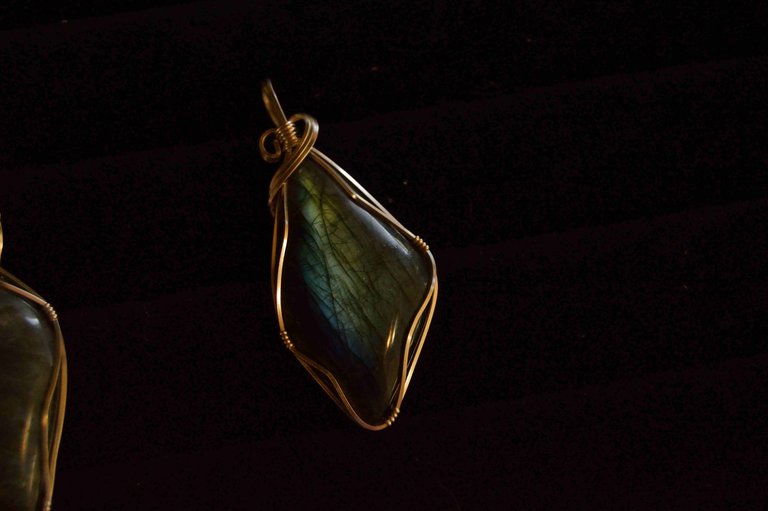
Twisted wire jewelry construction at close range. Photograph: Michael Kelly, CC0, via Wikimedia Commons. — Michael Kelly, Twisted wire jewelry, via Unsplash and Wikimedia Commons.

Step 2: Wipe gently
If the setting is sound, support the piece and wipe lightly with the clean, dry cloth. Wade's safe way was to wipe the spot, thus removing any powder. A true scratch will, of course, persist. Do not press harder at a dull mark.
Step 3: Avoid harsh treatment
Keep abrasive powders, stiff brushes, scratch tests, bleach, ammonia, steam, and ultrasonic machines away. Avoid sudden heat and hard knocks. Remove the piece for rough work, bathing, swimming, creams, and sprays.
Step 4: Store separately
When it is dry, lay it flat in a soft pouch or its own lined compartment. Leave the cord loose. Keep harder stones, chain edges, and clasps from rubbing the face.
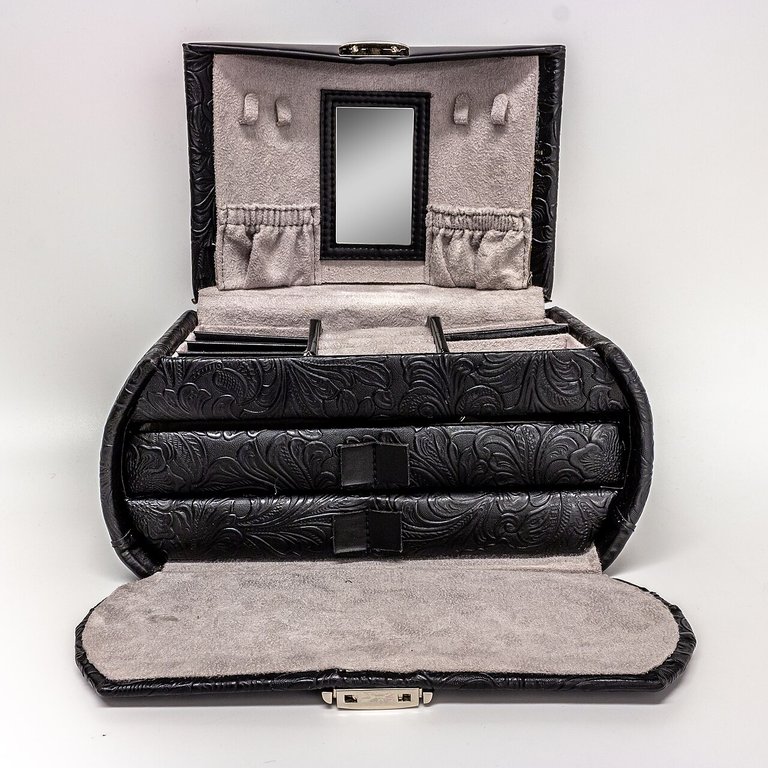
A divided jewelry box gives each piece a separate lined space. Photograph: W.carter, CC BY-SA 4.0, via Wikimedia Commons. — W.carter, Black jewelry box in embossed leather imitation 3, via Wikimedia Commons.

The Celestial Relic: Labradorite Soul Transformation Pendant is one irregular faceted stone, held by a gold-tone wire wrap on a thin black cord. From most angles it looks quiet: smoky gray, a little ordinary. Then the light finds it, and a blue-to-gold flash moves across the facets. Inspect the wire and round bail, wipe lightly, and let the 20-inch cord lie loose in its own soft compartment.
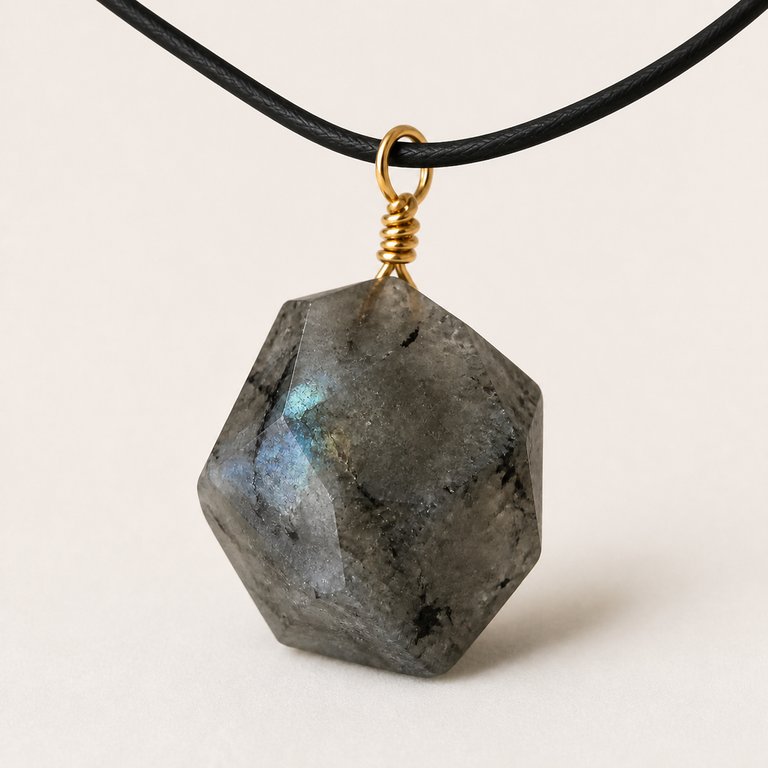
The current Celestial Relic Labradorite Soul Transformation Pendant from the Karma Items product listing.
At the folding table: look, wipe, and give it one place.
Craig Lembke
About Craig Lembke

Craig Lembke lives in Gresham, Oregon. He spent twenty-three years speccing rooftop HVAC units, then set a folding table up in the garage when the company thinned out. A resin-and-metal pyramid sits next to the laptop. He found Wilhelm Reich in a library remainder stack and still cannot tell you how much of it is solid. He wants the object explained without a speech.