
Labradorite Meaning: A Simple Guide to the Stone and Its Flash
Labradorite is a gray stone that can flash blue, green, or gold when you turn it in the light. Its spiritual meaning is tied to change, intuition, and protection. In plain words: starting a new chapter, trusting your own judgment, and keeping other people's worries from taking over your day.
At my folding table in Gresham, the stone is gray until I turn it toward the garage door. Then blue runs over the face. Turn it back and the blue is gone. That change is the first thing I want to understand about labradorite. The meaning makes more sense once you have seen the stone move in the light.
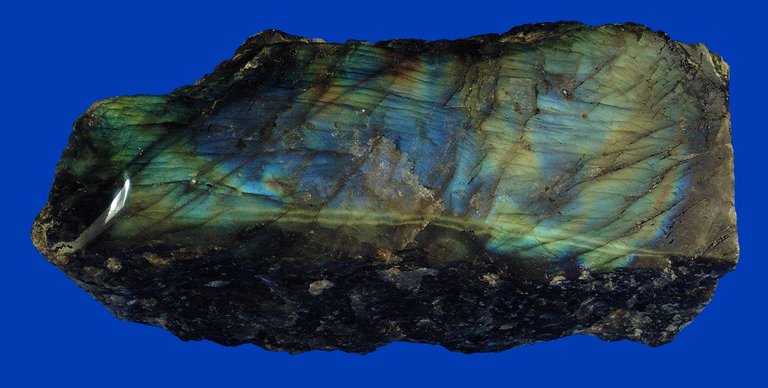
Polished natural labradorite with broad green, turquoise, blue, and gold flash. Photograph: Twyla Baker, CC0, via Wikimedia Commons. — Twyla Baker, Labradorite GeoDIL number 939, via Wikimedia Commons and the Digital Atlas of Ancient Life.

What is labradorite?
Labradorite belongs to the feldspar family, a group of minerals found in many rocks. It takes its name from Labrador in Canada, where it was first identified. It is also found in other places, including Madagascar and Finland.
Its body is usually gray. The bright color is a flash you see at certain angles. It may spread across the face, cross it in a streak, or show only at one edge.
I look at both: the gray stone and the color it reveals. You will see both when you wear it.
Why does labradorite flash blue or green?
The flash is called labradorescence. The word is long; the idea is simple. Very thin layers form inside the stone as it slowly cools. Light reflects from these layers, producing the colors you see.
Change the angle and the flash can sweep across the stone, shrink, or disappear. The stone has not lost its color. You have changed the way the light reaches your eyes.
When choosing jewelry, turn the stone. One still photo cannot show every view.
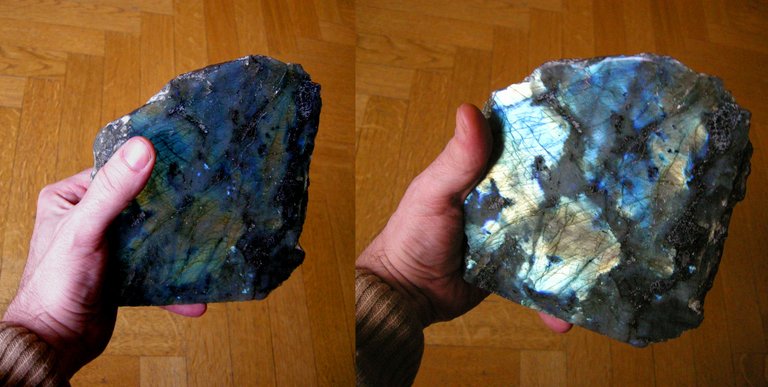
Labradorescence visible across a natural labradorite surface. Photograph: Prokofiev, CC BY-SA 3.0, via Wikimedia Commons. — Prokofiev, Labradorescence, via Wikimedia Commons.

What does labradorite mean?
Labradorite is often called a stone of transformation. Think of its gray face revealing a patch of blue. That change gives a visible shape to the idea of a new beginning: there is more to see than you noticed at first.
People wear it during changes in their own lives. A new job, a move, or the end of a relationship can leave you unsure of what comes next. A pendant gives you something you can touch while you take a moment to gather your thoughts.
You may also see older meanings attached to the stone. In his 1922 book, The Magic and Science of Jewels and Stones, Isidore Kozminsky linked labradorite with Aquarius. That was his astrological association. You do not need to know astrology to enjoy the stone or choose a meaning that matters to you.
I find the visible change the easiest place to start. Gray first, then blue when the light is right.
What do intuition and protection mean here?
Intuition means trusting your own judgment. You may have heard advice from three people and still need to decide what you want. Wearing labradorite can be a reminder to pause, put the phone down, and listen to your own answer before asking someone else.
Protection means keeping your own energy. In crystal traditions, labradorite is worn as a shield against unwanted energy. In daily life, that may mean leaving a tense conversation without carrying it into the rest of your evening, or saying no when you already have enough to do.
There is no complicated routine to learn. Wear the stone, or keep it where you will see it. Touch it before a decision or when a room feels too busy. Choose one meaning you want to remember. You do not have to use every meaning attached to it.
How to choose a labradorite stone
Look first at the body color. Then move the piece slowly and see where the flash begins. A broad blue field is not better than a small gold edge; it is only different. Choose the stone whose gray face and bright face both please you.
Look near a window and in ordinary room light, not only under a seller's lamp. If you are buying online, a short video can show how the flash changes as the stone turns. Check whether the pictures show the exact stone you will receive or an example of the design.
Natural stones vary. Dark marks and small features inside a stone are called inclusions. They are part of its appearance. A crack reaching an edge deserves a closer look. If a line worries you, ask for a close photo before choosing.
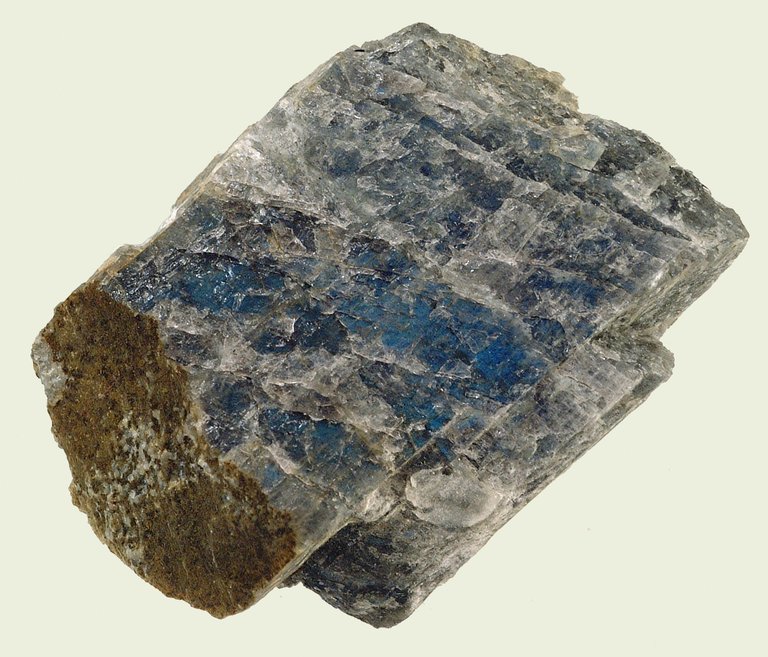
A rough labradorite specimen shows the gray body and limited blue patches that remain when a broad flash is absent. Photograph: Darla Sondrol, CC0, via Wikimedia Commons. — Darla Sondrol, Labradorite GeoDIL number 2380, via Wikimedia Commons and the Digital Atlas of Ancient Life.

Check the necklace as well as the stone
See the complete piece, including the wire or prongs that hold the stone and the loop where the cord passes through. Check that the stone sits securely and that the setting has no sharp ends.
Match the cord length and weight to the way you will wear it. A close-up of the stone tells you little about where it will sit on your chest. Look for a photo of the full necklace, too.
The labradorite jewelry care guide covers cleaning, drying, and separate storage.
One labradorite pendant to look at
The Celestial Relic: Labradorite Soul Transformation Pendant is one irregular faceted gray stone with a blue-to-gold flash. A gold-tone wire wrap holds it beneath a round loop, and it comes on a 20-inch black cord.
Look at the stone from more than one angle. Check the wire around the edge and the way the cord lets it rest near the chest. Each natural stone has its own marks and flash.
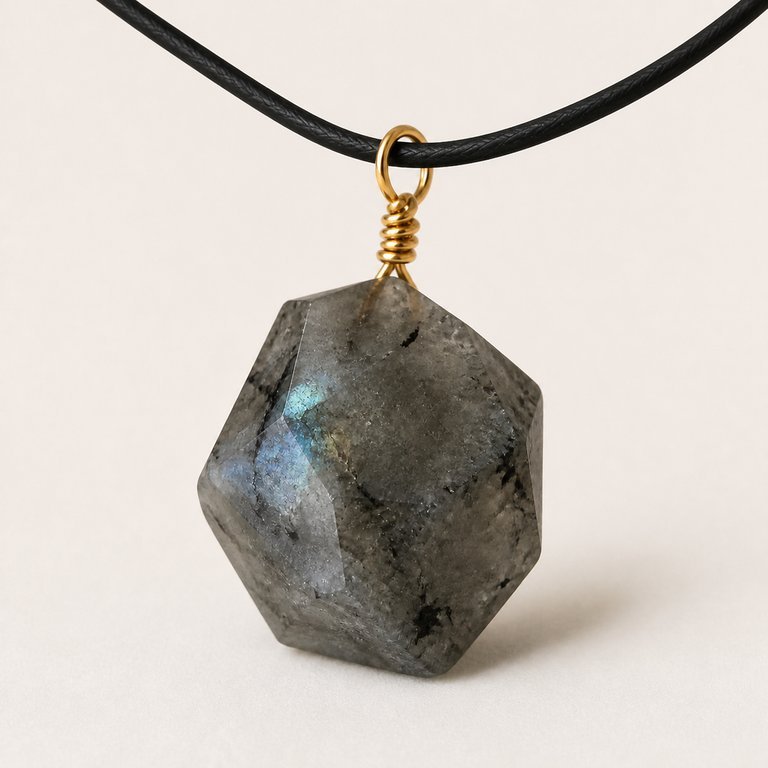
The current Celestial Relic Labradorite Soul Transformation Pendant from the Karma Items product listing.
My garage table is still more desk than altar. I like being able to look at the object first and understand what I am seeing. With labradorite, that starts with one small turn toward the light.
Craig Lembke
About Craig Lembke

Craig Lembke lives in Gresham, Oregon. He spent twenty-three years speccing rooftop HVAC units, then set a folding table up in the garage when the company thinned out. A resin-and-metal pyramid sits next to the laptop. He found Wilhelm Reich in a library remainder stack and still cannot tell you how much of it is solid. He wants the object explained without a speech.